Person
Alexander I
Emperor of Russia
Life: 1777–1825
The emperor who moved the centre of decision. The allied defeat was produced by his decision structure itself; later he turned to lead the coalition against Napoleon.
The 27-year-old Russian emperor. At Austerlitz he pushed hard for a decisive battle and dismissed the caution of the older Kutuzov, tilting the allied decision toward the offensive. A young appetite for glory and a hawkish court closed off the most rational option — to wait — and that internal dynamic was itself part of the structure of defeat. In later years he reversed course to lead the coalition against Napoleon, ending on the winning side.
Strategic signature — who gets to decide
Alexander I did not wield a sword on the field, yet his role was decisive. Where the allied centre of decision sat — that is what the emperor moved. His leaning toward a decisive battle, and the hawkish court that backed it, closed off the most rational option of all: to wait.
Recurring patterns
The locus of decision
Who decides in the end. When he leant to the offensive, the whole army's centre of gravity moved with him.
Glory and court dynamics
A young emperor's appetite for honour and a hawkish entourage swept caution aside.
Dismissing caution
He overrode Kutuzov's "wait" and chose battle. Atmosphere and will decided it, not intelligence.
A later reversal
After the defeat he turned about to lead the coalition against Napoleon, ending on the winning side.
Strengths and weaknesses
Decisiveness — later channelled into leadership of the European coalition against Napoleon.
At Austerlitz that decisiveness was exercised on a false premise. A decision structure with no brake can sprint full speed off a cliff.
The emperor built into the structure of defeat
The allied defeat was a problem of the decision structure before it was a failure of tactics: a command that could not stop its own caution from being overruled. At the centre of that gravity sat Alexander. His decision was itself part of the structure of defeat.
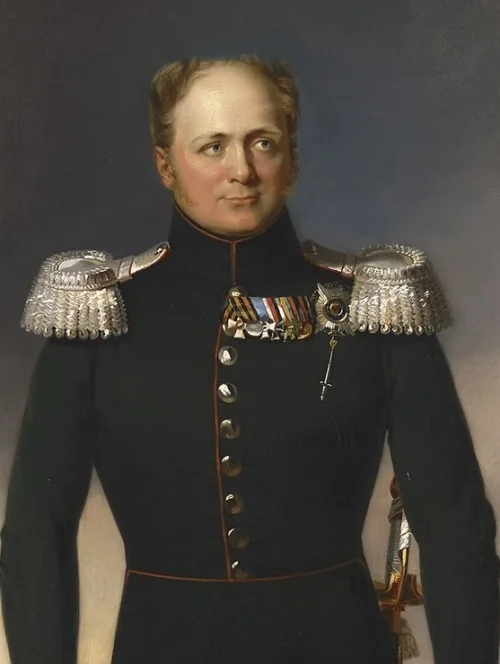
George Dawe, Portrait of Alexander I, c. 1825, oil, Royal Collection (UK). Public Domain, via Wikimedia Commons
Appears in