Austerlitz — the design that made the enemy abandon the centre
What made Austerlitz a masterpiece was not the brilliance of the central breakthrough. Napoleon gave up the central heights and made the enemy attack them — the outcome was decided, before the blades met, by the design of inducement.
- The outnumbered Napoleon won. The masterpiece was not the breakthrough but the design that made the enemy "abandon" the central heights and empty the centre.
- The allied decision was rational at the time — on the false premise that "the French right is weak," inside a command structure that could not stop its own caution being overruled.
- The outcome was tilted before the blades met. The fog and the charge were staging; the decisive factor was a design built before the battle.
The protagonist is shown in blue, the opponent in red.
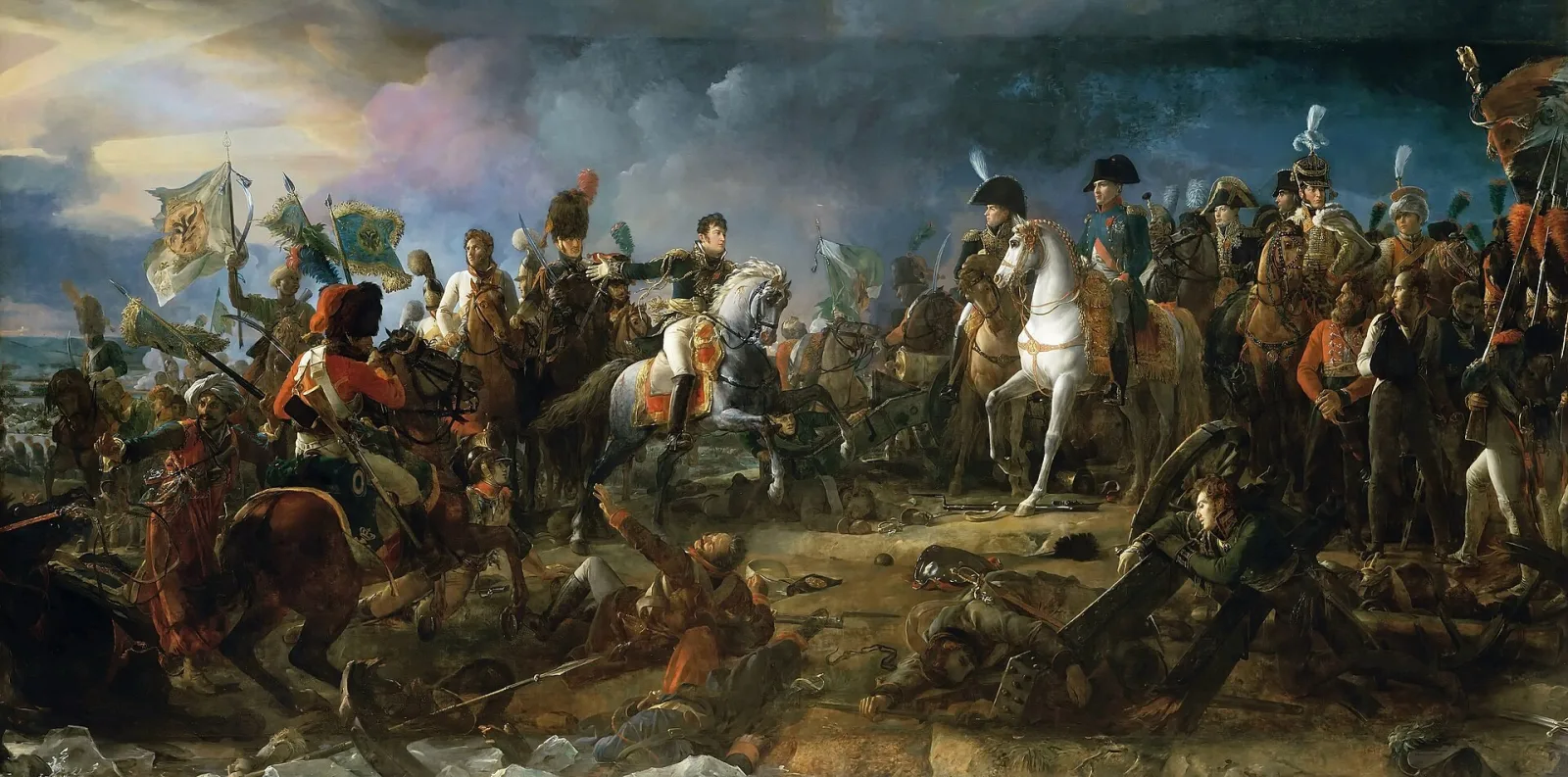
- Date
- December 2, 1805
- Place
- Moravia (now Czech Republic)
- Parties
- 3
- Result
- Decisive French victory
Contents
- Background — why did the side that profited from waiting attack?
- Forces — the French were outnumbered
- Forces and losses, compared
- Deployment — the ground Napoleon chose
- The thesis — the heights he "gave up" were the trap
- Two layers — the surface fight and the design beneath
- The course — it was not over in half a day
- Breaking down the win — what actually decided it
- Fog as accomplice — how the asymmetry was built
- Why the losers were not fools
- Aftermath — one battle ended an alliance
- The story — "the sun" and the exaggerated ponds
- Counterfactuals — remove one factor at a time
- For today — across other fields
- In closing — the issue was settled before the blades met
Background — why did the side that profited from waiting attack?
In October 1805 Napoleon forced an Austrian army to surrender at Ulm, and by November he had entered Vienna. Yet every mile of advance stretched his supply lines thinner, and winter was closing in. Prussia might join the coalition; Russian reinforcements were massing in the east. Time was on the allies' side1.
So the French needed to force a decisive battle before the strategic clock ran out. For the Russo-Austrian allies, the wiser course was simply to wait: they had the numbers, and more were coming. And yet they chose to attack. Why did the side that profited from waiting decide to advance? The structure of the whole battle is compressed into that single question2.
The answer is that Napoleon made them believe attacking now would win. He performed weakness — pulling his line back, floating peace overtures, behaving as though his army were shaken23. This was not a victor's tale told afterward; it was a move played before the battle began.
The allies had their own reasons. Around Tsar Alexander I gathered a party of hawks eager for an early blow, and the young emperor's appetite for glory pushed the same way. The older Kutuzov argued for the patience that made time an ally, but in the atmosphere of the court his caution did not carry12. The most rational option — to wait — had been closed off by the internal dynamics of the alliance.
Forces — the French were outnumbered
Sources vary. The French numbered about 65,000–75,000, the allies about 84,000–89,00012. Davout's corps, force-marched up from Vienna, would hold the thin right in the south1.
Forces and losses, compared
| French (protagonist) | Allies (opponent) | |
|---|---|---|
| Strength | ~65,000–75,000 | ~84,000–89,000 |
| Guns | 157 | ~278–318 |
| Casualties (killed, wounded, captured) | ~8,500–9,300 | ~27,000–36,000 |
| of which captured | — | ~12,000 |
Figures vary by source, especially for losses. The point is the asymmetry: the smaller army inflicted far heavier losses than it took12.
Deployment — the ground Napoleon chose
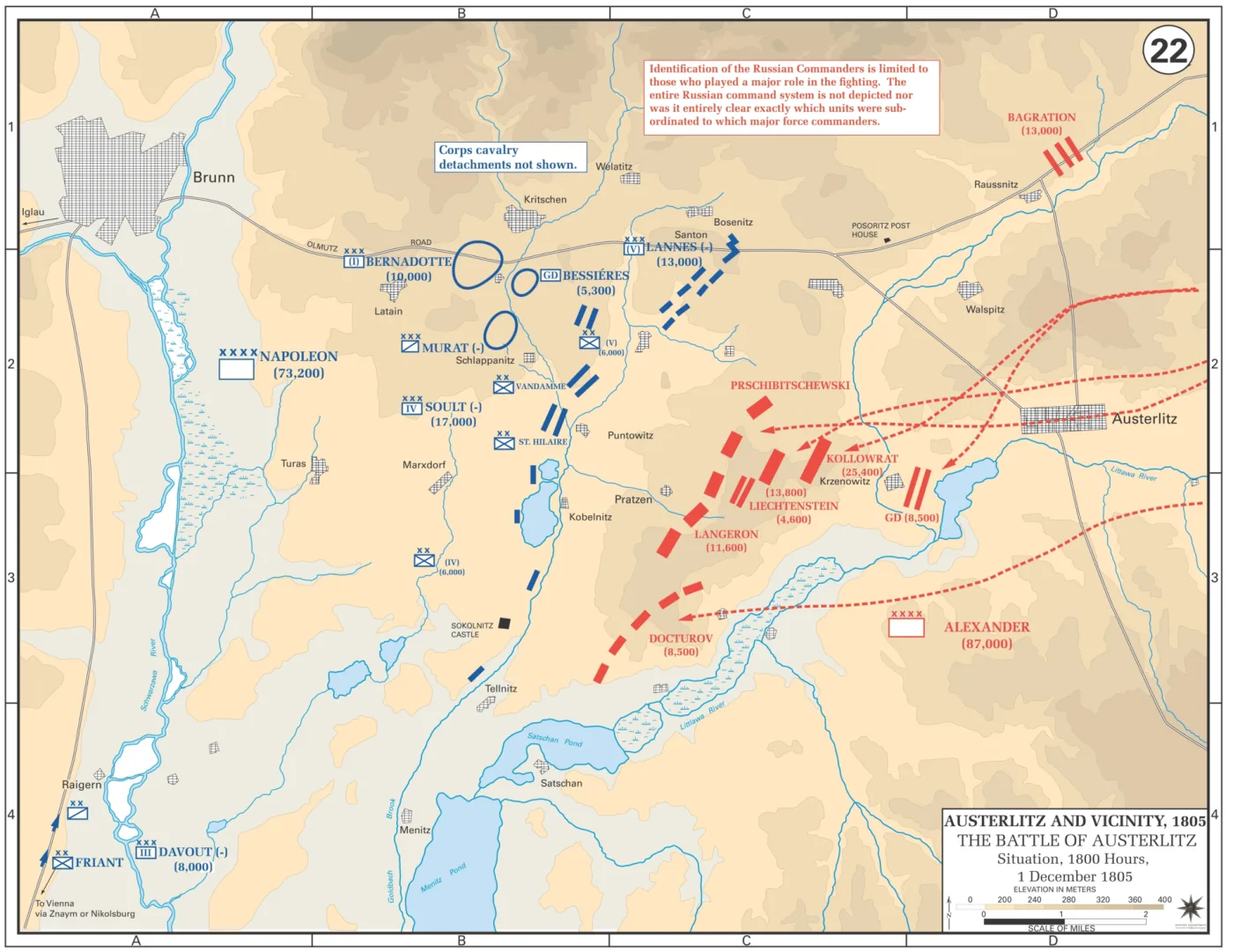
The terrain explains the design. The Goldbach stream ran north–south on the west; east of it rose the gently sloping Pratzen Heights; to the south lay a chain of ponds and marshes. The road to Vienna ran through that south — behind the French right12.
Napoleon deliberately set his right thin, near the ponds and the road, and yielded the central Pratzen Heights to the enemy. To the allies it looked like a perfect opening: envelop the thin right from the south and cut the French from their line of retreat. Napoleon offered the enemy exactly the ground on which they would want to attack. Choosing where to fight, and shaping the field itself into bait, was the first move of the battle23.
Terrain is never neutral. The same heights can be a position to hold or bait to lure the enemy down. The more firmly the reader believes "high ground must be taken," the better a design that turns that belief against them will work.
The thesis — the heights he "gave up" were the trap
By convention, commanding high ground like the Pratzen plateau is a position to seize and hold. Instead Napoleon pulled his troops off it and made his southern right — near the Vienna road — look deliberately weak23.
The allies read it as opportunity: wrap the thin right, sever the French from their retreat, and destroy them. To do it they slid their main body down off the Pratzen Heights toward the south. The more they pressed, the more they emptied their own centre. Making the enemy vacate the centre was itself Napoleon's design. The heights he appeared to "give up" were the bait2.
Most accounts praise the dash of Soult's assault that followed. But the assault only worked because the enemy had come down off the heights. The set piece is the breakthrough; what decided the battle was the chain of inducement that got the enemy to descend. Dazzled by the brilliance of the result, we miss the real cause — a design assembled before a shot was fired. The masterpiece is not the breakthrough, but getting the enemy to build the conditions for it themselves23.
The outcome was already heavily tilted, before the blades met, by the design of inducement.
Thesis
Two layers — the surface fight and the design beneath
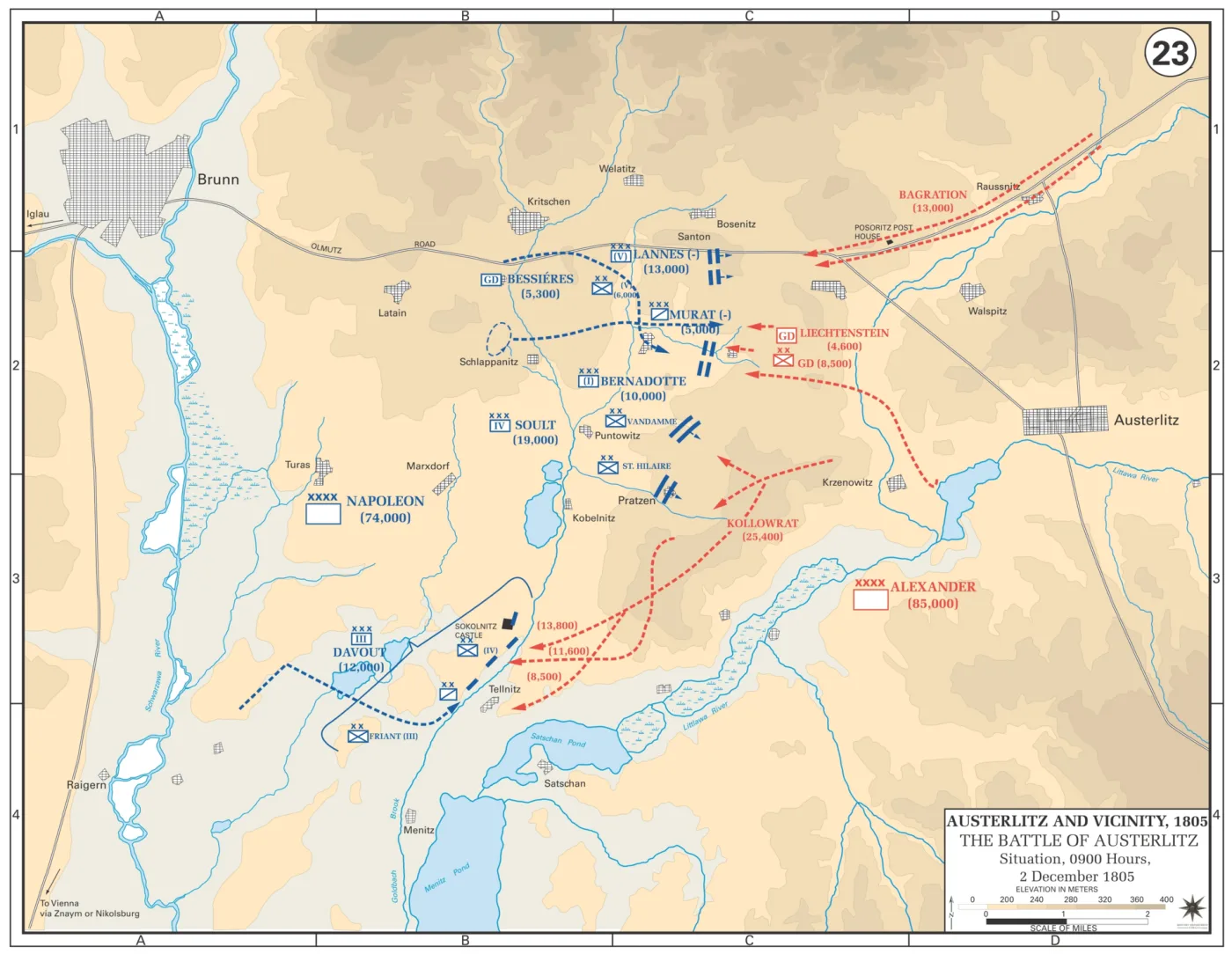
The allies poured into the southern wing (Telnitz/Sokolnitz), pressing the thin French right.
As the fog lifted, Soult's corps stormed the central Pratzen Heights.
The assault waited until the enemy had come down off the heights. Timing — not the brilliance of the breakthrough — was the heart of it2.
With the heights lost, the allied army was cut in two, and the southern troops lost their line of retreat.
Break the enemy's spine with concentrated force, scatter it, then deal with the pieces one by one — one design from start to finish3.
The course — it was not over in half a day
The allies began sliding their main body off the Pratzen Heights to the south. Napoleon had been waiting for exactly this2.
Thick fog blanketed the low ground. Neither side could see the other's deployment — and the French main body stayed hidden1.
The allies attacked the southern wing at Telnitz/Sokolnitz. Davout's corps held against the odds, and the fighting there ran long12.
With the allies down off the plateau, Soult's corps burst through the fog onto the heights, striking the moment the centre thinned2.
The French took the heights. The allied army was split, its command severed in two1.
Breaking down the win — what actually decided it
The design of inducement
Make the enemy believe "attack here and you win," and move their weight where you want it. The issue was largely settled before the blades met2.
Control of timing
The assault on the heights would fail if launched too early or too late. The discipline to wait until the enemy had descended was the heart of the design2.
Concentration of force
Separate where to look weak from where to mass the blow. The allocation of show card and main effort turned a numerical deficit into local superiority3.
Fog as accomplice — how the asymmetry was built
The day's thick fog is often told as luck. But the fog only completed an inducement already laid. It hid the French main body and let the allies trust "what they saw." The real asymmetry was built before any fog appeared12.
The performance of weakness, the ceded heights, the peace overtures — much of the picture the allies drew had been drawn by Napoleon. "Information superiority" here did not mean gathering more facts. It meant authoring the picture the enemy sees. Let the enemy observe correctly, and make even that correct observation lead them astray. It is the most transferable lesson of the day — to markets and negotiations alike.
Why the losers were not fools
Pause here. The allies' decision was rational on the information they had. Envelop a weak-looking right, cut its retreat, destroy it — the orthodox move for the side with more men2. They were not reckless; they acted correctly on a false premise.
What broke was not the tactics but their foundation. "The French right is weak" was a manufactured illusion, and the danger of emptying the centre was invisible. The allied decision structure was brittle, too: Kutuzov's caution was overridden by an emperor and a court hungry for battle1. When a false premise met a command that could not stop, sound tactics simply became the speed of defeat.
Here is the core of "structural defeat." The allies did not lose because they were weak or incompetent. They executed a judgment that would have been right on a true premise — on a false one, and inside an organisation that could not turn back. That is why their defeat is not someone else's problem. Anyone who cannot question a given premise, and has no mechanism to stop, can sprint full speed off the same cliff. Read with yourself in their place, not laughing at them, and the case finally becomes useful2.
Aftermath — one battle ended an alliance
Within days Austria sought an armistice, and the Treaty of Pressburg on 26 December effectively dissolved the Third Coalition. Alexander's Russian army withdrew east1. A single decisive battle had broken an alliance of great powers.
By Pressburg, Austria accepted territorial losses and indemnities, and the core of the coalition fell away. Russia, though badly hurt, made no peace and chose to fight on. One battle broke the alliance, but it did not end the war — a distinction that matters if we are not to overrate the decisive battle1.
The consequences widened. In 1806 the Holy Roman Empire was dissolved and the Confederation of the Rhine formed under Napoleon's patronage. Austerlitz was not merely a tactical victory but the starting point of a redrawn political map of Europe12. Yet these were events that unfolded through the door the battle opened, rather than its direct "results" — best read as a sequence, not a single straight line of cause.
The story — "the sun" and the exaggerated ponds
A victory is recast as story the moment it happens. The sun breaking through the fog became "the sun of Austerlitz," a symbol of the Napoleonic legend ever after. The dramatic image was polished as a victor's tale, but details such as the hour the fog cleared differ across sources: performance and fact must be read apart.
A clearer example is the tale that the retreating allies were driven onto the frozen ponds and drowned en masse. Napoleon's official bulletins reported figures in the thousands, even twenty thousand; but when the ponds were later drained, far fewer bodies were found23. As at Marengo, the distance between "what happened on the field" and "the story the report built" reappears here. The victor's numbers must never be fed straight into an analysis of why he won.
Do not overlook that making the story is itself a strategic act. A victory's meaning is fixed not on the field but in the telling that follows. The exaggerated drownings, the dramatic sun — they raised morale, cowed the enemy, and propped up the emperor's prestige. Only by including "how it was told," not just "what happened," can this battle be understood. We separate fact from staging not to deny the power of the story, but to size it correctly.
Counterfactuals — remove one factor at a time
A: If the allies had not moved off the heights. Napoleon's inducement misfires and the centre stays thick. The numerical gap tells, and the French likely lack a decisive blow.
B: If the French assault on the centre had come an hour earlier. The allies are still on the heights, and the attack is thrown back head-on. The design worked only because it "waited."
C: If Kutuzov's caution had prevailed. The decisive battle is avoided, and time — the allies' greatest weapon — keeps working for them.
Each of these is an untestable thought experiment, not a claim about what was. Only by removing a factor does its weight become visible.
For today — across other fields
Markets: show weakness to lure
Leave the low end or the periphery deliberately open, draw the rival's main effort there, and win in the high-value core. Why this example: the same structure of letting the opponent choose where to strike, then using that very choice.
Sport: give space to take it
Leave one flank open on purpose, draw the opponent across, then finish in the space on the far side. Why this example: "giving space" becomes part of the attack, not the defence — the abandoned heights again.
Negotiation: concede to take control
Yield big on the trivial points, let the other side attack and feel satisfied there, and win on the clauses that matter. Why this example: it is a design to move the counterpart's focus to where you want it.
In closing — the issue was settled before the blades met
Summarise Austerlitz as "a masterpiece of central breakthrough" and you miss the core. What was masterful was not the breakthrough itself but the design that made the enemy abandon the centre. Perform weakness, let the enemy choose where to strike, and use that choice — the outcome was already heavily tilted before the blades met.
The stronger side did not win. The side that read the opponent's reasoning and built it into its own blueprint won. The reason the case is still read is that the same structure recurs off the battlefield too — in markets, in negotiations, in sport.
This is exactly why this site reads cases as structure rather than heroic legend: not who was great, but which premise was held by whom, and at which moment what gave way. Dissect that, and a single day in the past becomes a lesson you can carry into the present. Praising the victor's brilliance teaches nothing reusable; read as structure, the same question can be posed far from any battlefield — which premise am I now sprinting on without questioning? Austerlitz is the first model of how to read.
Frequently asked questions
Sources
- David G. Chandler The Campaigns of Napoleon,Macmillan(1966)
- Robert Goetz 1805: Austerlitz — Napoleon and the Destruction of the Third Coalition,Greenhill Books(2005)
- Scott Bowden Napoleon and Austerlitz,Emperor’s Press(1997)
Related cases — read in comparison