Person
Mikhail Kutuzov
Russian commander-in-chief (in effect)
Life: 1745–1813
The veteran who made time and patience his weapons — winning by waiting for the enemy to overreach. Overruled at Austerlitz, vindicated in 1812.
The veteran who argued to the end against forcing a decisive battle. He saw that time favoured the allies and pressed the case for patience, but was overruled by Tsar Alexander I and a hawkish court. Once the offensive began on a false premise, all he could do was limit the collapse. In 1812 he would take his revenge on Napoleon with exactly this strategy of waiting.
Strategic signature — winning by waiting
Kutuzov's way is the opposite of Napoleon's. He did not rush a decisive battle; he traded space for time and waited for the enemy to overreach. Retreat and attrition were not defeat to him but an investment in winning.
His strength lay in judging not when to attack but when not to. When time is on your side, the wisest move can be to stay still.
Recurring patterns
Make time an ally
Count the conditions that improve with waiting — reinforcements, supply, winter. A decisive battle throws them away.
Retreat and attrition
Give ground to stretch the enemy, then grind down what is overextended. Not defence, but a slow attack.
Avoid the gamble
Never stake everything on one battle. Even when shaken, keep the whole intact for the next round.
Unable to resist organisational gravity
At Austerlitz his sound caution was overruled by emperor and court. Being right and being able to prevail are not the same.
Strengths and weaknesses
Reads the long game. In the 1812 Russian campaign this philosophy bears fruit as his revenge.
Caution only becomes power if you are allowed to act on it. At Austerlitz he lacked the authority to impose his read.
Two faces — Austerlitz and 1812
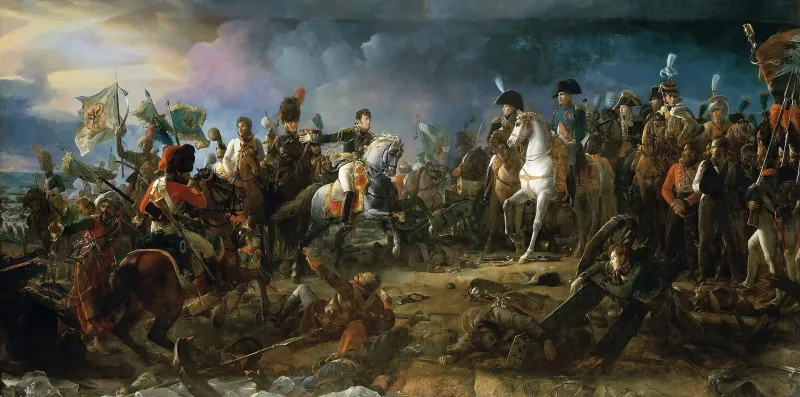
At Austerlitz, Kutuzov was overruled and commanded a defeat. Seven years later, with the same philosophy of waiting, he led Napoleon's overreach to destruction. The same person and the same idea produced opposite outcomes depending on who held the authority — a clean illustration of how much the command structure weighs.
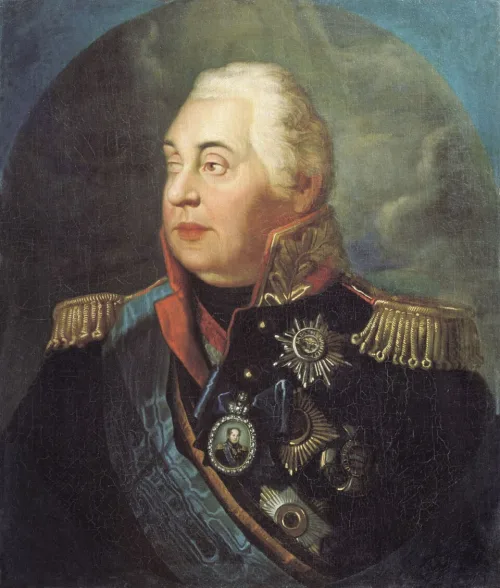
Roman Volkov, Portrait of Mikhail Kutuzov, early 19th century, oil. Public Domain, via Wikimedia Commons
Appears in