Person
Napoleon Bonaparte
Emperor of the French · Commander-in-chief
Life: 1769–1821
The commander who composed a battle as a single blueprint and made the enemy choose what he wanted. Austerlitz is where that signature showed most clearly.
Crowned emperor only the year before, at 36. His real gift at Austerlitz lay less in battlefield daring than in the power to compose a battle as a single blueprint — performing weakness, turning terrain into bait, and letting the enemy choose where to strike so he could use that very choice. To tilt the outcome before the blades met was his signature, and it left the clearest example of the "design of inducement" this site keeps tracing.
Strategic signature — engineering the battle
Reduce Napoleon to "genius" or battlefield daring and you miss the point. His real gift was to draw a single blueprint before the battle began — one that included the actions the enemy would choose. He performed weakness, turned terrain into bait, and let the enemy pick where to strike so he could use that very choice.
Tempo and concentration were the keys: wait until the enemy committed, then separate where he looked weak from where he massed his blow. The outcome was largely tilted before the blades met; what happened on the field was only the design checking its own answer.
Recurring patterns
Design of inducement
Make the enemy believe "attack here and you win," and move their weight where you want it. Read their reasoning and build it into your own plan.
Command of tempo
Hold the speed and distance, and strike the instant the enemy has committed. Too early or too late and it collapses; the restraint is the point.
Concentration of force
Separate the show card from the main effort, turning a numerical deficit into local superiority.
Operating the narrative
A victory's meaning is fixed not on the field but in the report and the telling. He moved numbers and staging alike for morale and prestige.
Strengths and weaknesses
Reads the opponent's judgment and moves them as predicted. The more the enemy knows the textbook, the more it can be turned against them.
The design assumes the enemy cooperates. When they refuse to fight on his terms and choose attrition, his edge fades.
Enough decisive power to break an alliance in a single battle.
The same offensive bent can tip into overreach. The seed of the weakness exposed in Russia in 1812 is already here.
Where the signature showed — Austerlitz
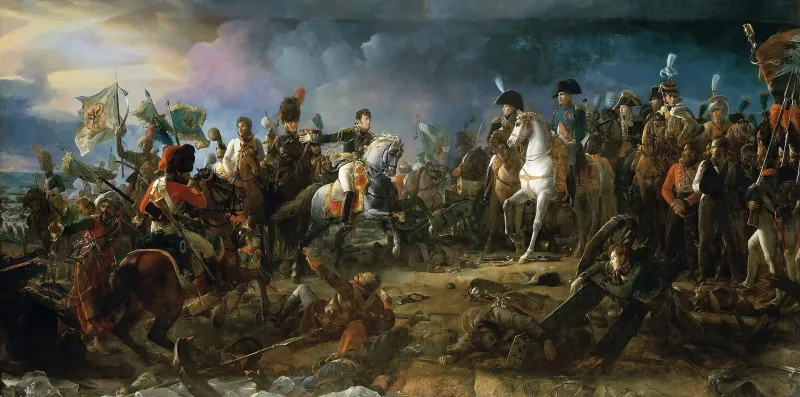
Austerlitz is where this signature showed most clearly. He gave up the central Pratzen Heights so the enemy would attack and empty the centre. The masterpiece was not the brilliance of the breakthrough but the design that made the enemy build the conditions for it themselves.
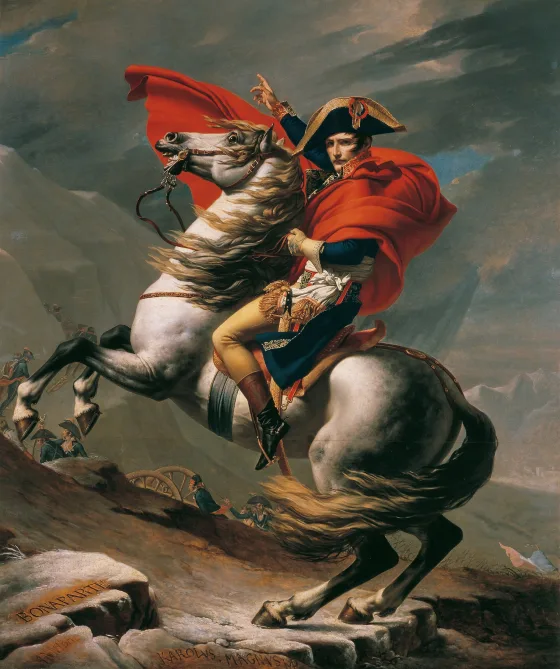
Jacques-Louis David, Napoleon Crossing the Alps, 1802–1803, oil on canvas, 246 × 231 cm, Österreichische Galerie Belvedere, Vienna. Public Domain, via Wikimedia Commons
Appears in