Person
Hannibal Barca
Carthaginian general (247–183/182 BC)
The designer who absorbed the enemy's momentum to redirect it, turning a numerical deficit into annihilation by encirclement. Cannae was his peak — but he could not turn the win into a result.
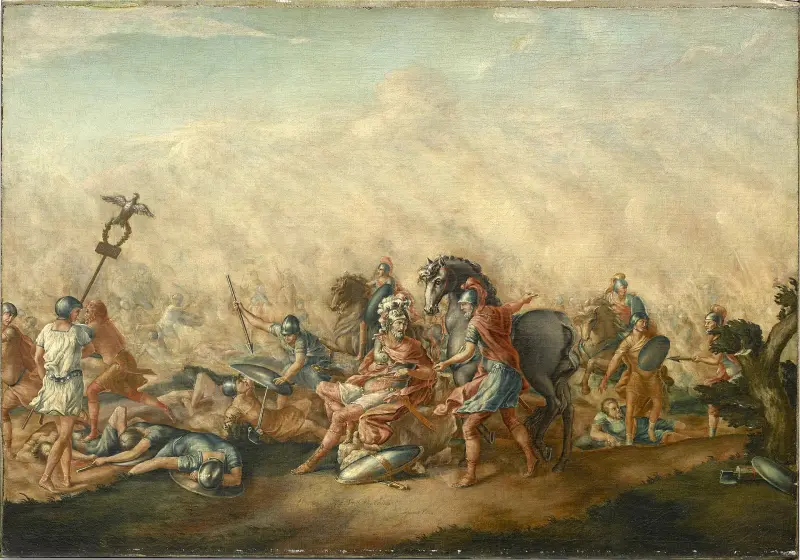
The Carthaginian general who crossed the Alps into Italy. At Cannae, around the age of 31, he annihilated a Roman army nearly twice his size in a single day. His real gift lay less in daring than in the power to build a battle — including the enemy's momentum — into one design. Yet, lacking siege power, supply and support from home, he could not convert a total tactical victory into a strategic one, and finally yielded to Rome's capacity to rebuild.
Strategic signature — building the enemy's momentum into the design
Hannibal's strength was not daring or any single tactical trick, but the power to draw a single plan before the battle that included the actions the enemy would choose. He read what the enemy held to be rational and where they would put their weight, and made that very rationality a component of the trap.
At Cannae, for an army with the numbers, "pack deep and push through" was the obvious choice. He turned that obviousness against them — receiving the push in a forward-bowed centre, letting it press in, and closing the wings and rear. The enemy's own forward momentum became the force that completed the encirclement.
Recurring patterns
Use the enemy's momentum
Do not stop the enemy's lunge; absorb it and change its direction. Turn the advance itself into the engine of encirclement.
Combine the arms
Receive with the infantry centre; take the flanks and rear with superior cavalry. Separate the holding role from the deciding role.
Design the envelopment
Overturn a numerical deficit with local superiority and placement. Design not the shape, but the steps that produce it.
Command a mixed army
He moved a patchwork of Libyans, Iberians, Gauls and Numidians as one machine by giving each a role.
Strengths and weaknesses
Battle design at the highest level of antiquity. He overturned the numbers and erased Rome's strongest army in a day.
That design was confined to the battlefield. Lacking siege power, supply and support from home, he could not convert total tactical victory into strategic victory.
Reads the enemy's reasoning and redirects their momentum by absorbing it.
He failed to see — or, seeing, could not act on — that Rome would not surrender after a single catastrophe, and so could not cash in the win.
Where the signature showed — Cannae
Cannae is where Hannibal's design showed most clearly. Yet the perfect tactical victory did not break Rome. The brilliance of how you win and the conversion of a win into a result are different problems — a separation that became the theme of his whole life.
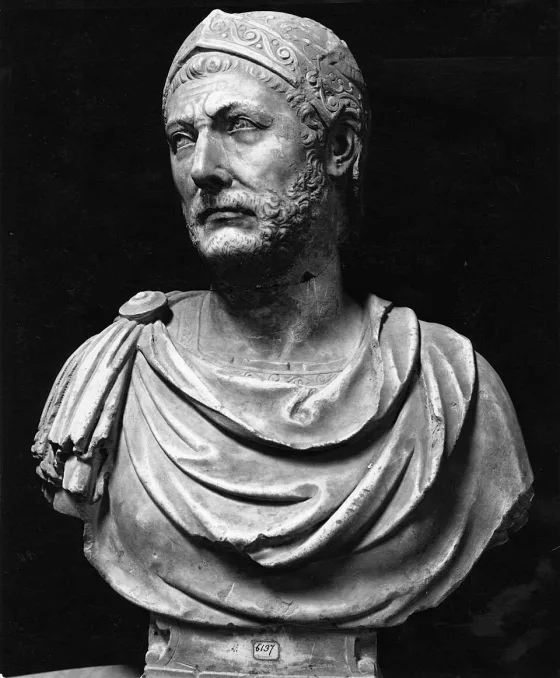
A bust traditionally identified as Hannibal (the identification is debated). Photo by Fratelli Alinari. Public Domain, via Wikimedia Commons
Appears in