Person
Horatio Nelson
British commander-in-chief (killed at Trafalgar)
Life: 1758–1805
The admiral who assumed signals would stop getting through and distributed intent in advance, so his captains could run without him — a design that outlived him by an afternoon.
The British admiral who, twelve days before Trafalgar, circulated a memorandum to his captains setting out how the fleet would be divided in two to cut the enemy line, and what each of them was for. It went as far as to say that if signals could neither be seen nor understood, a captain could not do very wrong by placing his ship alongside an enemy. That is not encouragement; it is a specified default for after the chain of command breaks. He was shot during the action and died, and the fleet's way of fighting held to the end.
Strategic signature — designing for the moment orders stop arriving
Read Nelson as a man of bold charges and you miss him. What was unusual was that he took an obvious fact — once the firing starts, signals stop getting through — and built it into the plan as a premise. The memorandum he circulated twelve days before the battle explained the whole intention and each squadron's part, and added that if signals could neither be seen nor understood, no captain could do very wrong by placing his ship alongside an enemy.
That is not a stirring exhortation; it is a specified default for after the chain of command breaks. He built, in advance, the difference between an organisation that halts the moment the top can no longer direct it and one that keeps running.
Recurring patterns
Distribute intent first
Share the purpose, not the procedure. Give people what it is for, and they can answer unforeseen situations themselves.
Fix the default in advance
Decide now what to do when nobody can reach you. Put the ungovernable situation itself into the plan.
Close to a decisive range
Do not settle for a long-range exchange; get close enough to take or sink. No half-won victories.
Operate the narrative
Signals, and his own visible person, were handled as material for morale and reputation. He was his own best publicity.
Strengths and weaknesses
Can put subordinates into a state where they judge for themselves, before the battle begins.
That premise rests on the training and mutual trust of his captains. Transplanted to a less practised fleet, the same design does not run.
The will to press to a decision. Nothing gets away.
He stood at pistol shot himself, and was shot there. He did nothing to reduce the risk of the designer being the first to go.
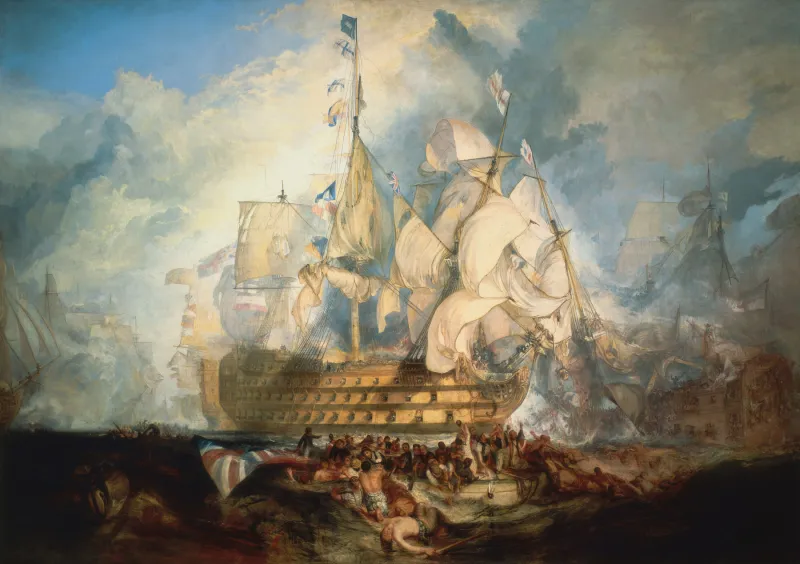
Where the signature showed — Trafalgar
During the action Victory's signal halyards were shot away and direction from the flagship did in fact stop. The fleet kept fighting anyway. That the shape of the battle survived the loss of its commander is itself the result of the design.
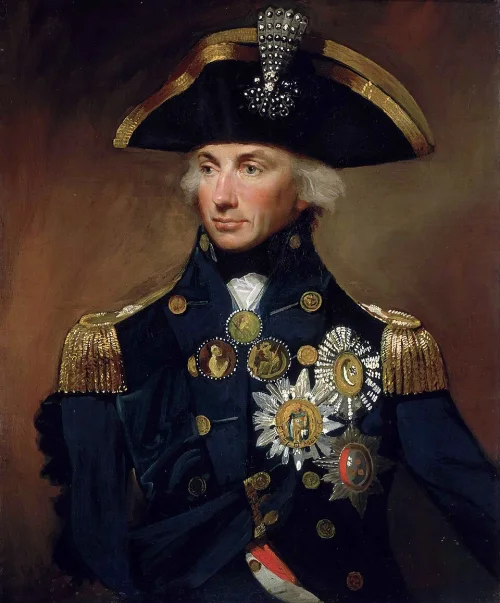
Lemuel Francis Abbott, Horatio Nelson, 1799, oil, National Maritime Museum, Greenwich. Public Domain, via Wikimedia Commons
Appears in