Person
Charles d'Albret
Constable of France
Life: 1369–1415
The constable who commanded the army in name and whose orders did not carry against the order of precedence.
On paper the commander of the whole French army. But the king and the Dauphin were both absent, and the field held princes who outranked him socially; a constable's authority thins out in front of precedence. Before the battle there was an option not to fight and to shadow the English instead, but honour and competition among the great lords pushed for advance. Unable to stop it, he took his place in the first line and was killed. He lost on the structure of authority, not the quality of the plan.
Strategic signature — the title without the reach
Charles d'Albret was Constable of France and, on paper, commander of the whole army. But King Charles VI was absent through illness, the Dauphin was absent too, and the men on the field included princes who outranked him socially. A constable's authority thins out in front of the order of precedence12.
Before the battle the French had the option of not fighting at all — shadowing the English to Calais and letting hunger do the work. Honour and competition among the great lords pushed for advance instead. Unable to stop it, he took his place in the first line and was killed there.
Recurring patterns
A commander inside a council
Formal command and the ability to actually move people are not the same thing.
Rank decides the deployment
The great nobility crowded into the honourable first line; precedence, not tactical need, shaped the formation.
Cannot stop it, so leads it
If you cannot stop the movement, at least stand at its head. And die there.
Strengths and limits
As commander of the whole army he held a coherent plan: dismount, and counter the archers.
He lacked the authority to have it executed. He lost on the structure of command, not the quality of the plan.
Connection to Agincourt
The French defeat was not a defeat of recklessness but a defeat of not having settled who decides. Like Villeneuve at Trafalgar, he lost on the executing side rather than the reading.
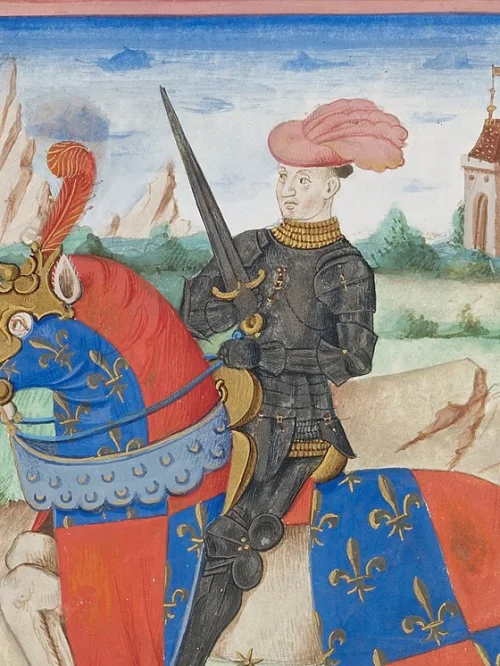
Charles d'Albret, from the Armorial de Gilles Le Bouvier, c. 1455, Bibliothèque nationale de France. Detail. An image made to display arms rather than a likeness. Public Domain, via Wikimedia Commons
Appears in