Agincourt — the design that gave numbers no room
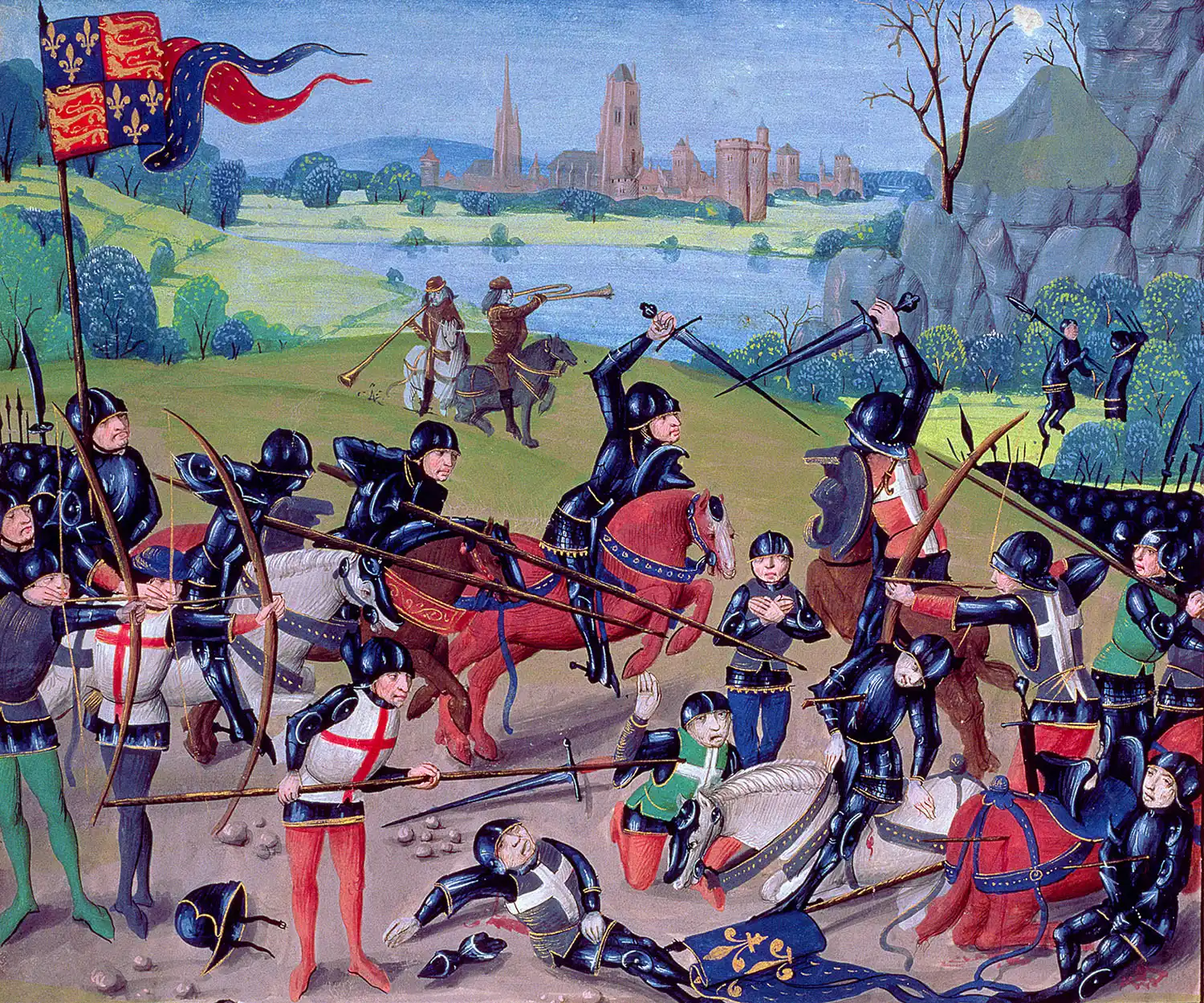
On 25 October 1415 an exhausted English army beat a more numerous French one. What gets told is the power of the longbow. But arrows rarely pierced good plate armour. What they did above all was push men toward the centre — and together with a narrow frontage between two woods and a field of mud, superiority in numbers turned into a density that could not move.
- Arrows rarely pierced good plate. What they did above all was push men toward the centre, away from the shooting — and with a narrow frontage and mud, that turned superiority in numbers into a density that could not move.
- The ratio itself is unsettled: one body of work puts it near one and a half to one, another at three to five. The premise of an overwhelming disparity is not proven.
- Choosing the width was not enough. It was the English who were starving, so Henry advanced and manufactured the enemy's reason to move. The choice of ground and the provocation are two halves of one design.
Pattern: a design of frontage →
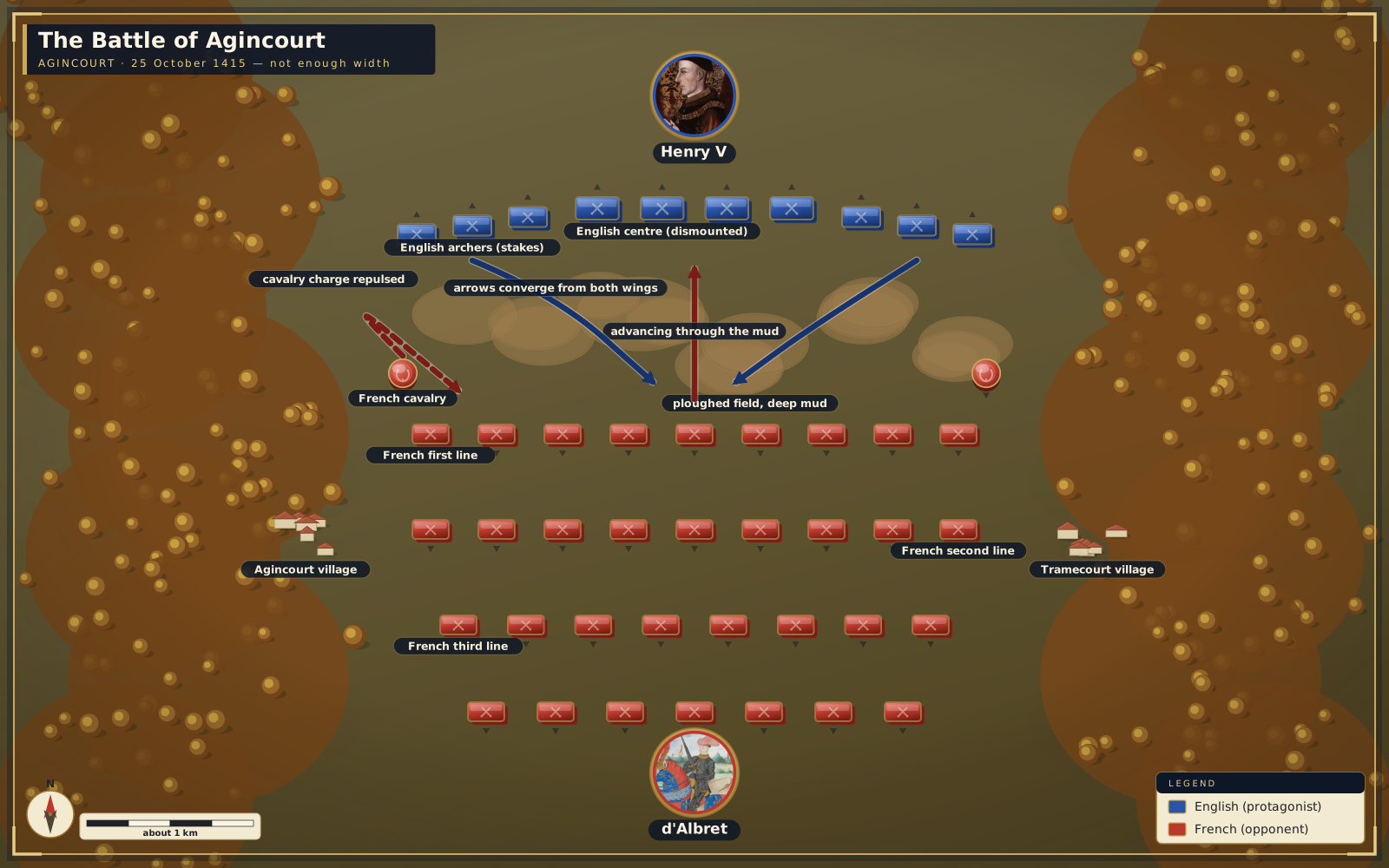
The protagonist is shown in blue, the opponent in red.
- Date
- October 25, 1415
- Place
- Near Agincourt, Pas-de-Calais, northern France
- Key figures
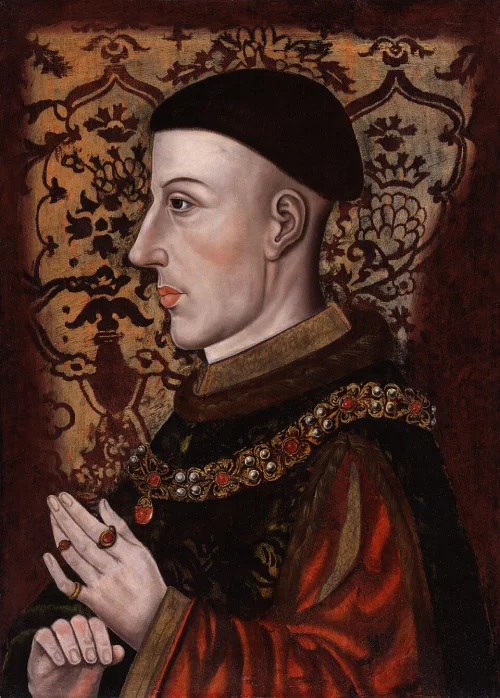
- 3
- Result
- Decisive English victory
Contents
- Background — why did an exhausted army accept battle?
- Forces — the ratio itself is disputed
- Forces and losses, compared
- Deployment — the width the woods decided, and a night of rain
- Thesis — not the longbow but a design of frontage
- Two layers — the surface fight and the design beneath
- The course — 25 October 1415
- What actually decided it
- Why the losers were not fools
- Aftermath — a total victory that depended on the winner's lifespan
- The story — an inflated ratio and the myth of the longbow
- Counterfactuals — remove one factor at a time
- What transfers — in other arenas
- In closing — numbers are superiority only once they have room
Background — why did an exhausted army accept battle?
In 1415 Henry V of England landed in Normandy and laid siege to the port of Harfleur. It took about 5 weeks, and dysentery went through the camp meanwhile, costing him more men than the fighting. The march for Calais with what remained ran some 420 km over 17 days, forced into detours by blocked river crossings, with the food running out12.
From the French side there was no need to fight at all. Shadow the English, cut them off from supply, and an exhausted army destroys itself. That option was in fact raised at the council. The French chose battle anyway, which is the first question.
The more important question is the other one. Why was it the clearly weaker English who could accept a battle? The structure of the day is compressed into that.
The answer is not the quality of the troops or the weapons. It is the dimensions of the ground. Henry drew up in a narrow ploughed field with woods on both sides. The frontage was about 750–900 metres13. The moment that width was chosen, the enemy's numbers stopped being an advantage and became "too many".
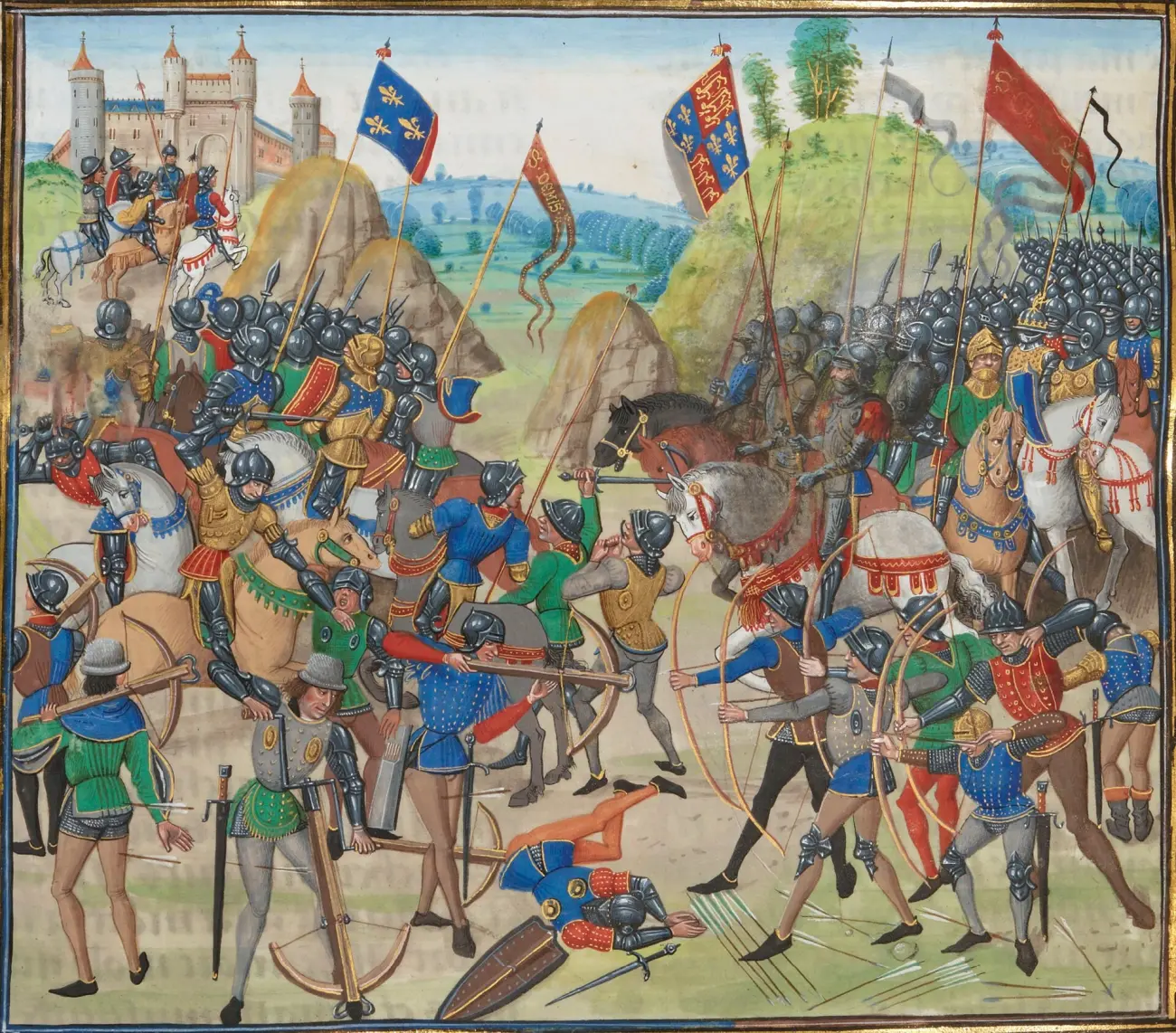
Forces — the ratio itself is disputed
In this case the ratio itself is unsettled. From the muster records Anne Curry puts it at roughly 9,000 English to 12,000 French — about one and a half to one1. Juliet Barker and Clifford Rogers argue for 20,000–30,000 French, which makes it three to five23. This site keeps the range rather than picking a number.
Forces and losses, compared
| English (protagonist) | French (opponent) | |
|---|---|---|
| Strength | c. 6,000–9,000 | c. 12,000–30,000 |
| Archers as a share | c. 80% | — |
| Killed | c. 100–600 | c. 4,000–10,000 |
| Prisoners | — | c. 1,000–2,200 |
| Length of the fighting | c. 3 hours | c. 3 hours |
The casualty figures also swing widely by source. What matters is the order of magnitude of the asymmetry. Four in five of the English were archers — this was not an army of knights but an army of the cheap arm that could be raised in numbers14.
Deployment — the width the woods decided, and a night of rain
The field lay between the villages of Agincourt and Tramecourt, with woods pressing in from both sides. What lay between those two woods was the whole battlefield: about 750–900 metres across13.
The English plugged the gap in a single line — dismounted men-at-arms in the centre, archers on the wings, and in front of the archers sharpened stakes driven in at an angle. A stake is not a device for killing horsemen; it is a device for creating ground horsemen cannot reach.4
The French had brought the lesson of last time. Having seen mounted charges broken by archery at Crécy (1346) and Poitiers (1356), they planned this time to dismount most of their men-at-arms and to confine the cavalry to attacking the flanks of the English archers12. The opponent had learned.
But that plan assumed width in which to reach a flank. With woods on both sides there was nowhere to go round. So the French could not fit across the frontage and stacked three and four lines deep. Worse, the great nobility crowded into the honourable first line, so the formation was shaped by precedence rather than tactical need12.
Last, the ground. Rain overnight had turned freshly ploughed field into mud. Walk a few hundred metres through that in armour and you are spent before contact. Nobody designed it, and it was among the conditions that told most that day23.
Thesis — not the longbow but a design of frontage
The battle is usually explained as English longbows shattering French knights. But recent scholarship and shooting trials show that penetration of good plate armour was limited4. Arrows did sometimes get through, but killing armoured men through their armour was not what decided the day.
So what did the arrows do? They killed horses, found the places armour was thin, forced visors down and took away sight and breath — and they pushed men away from the arrows, which is to say toward the centre. With archers converging from both wings, a packed crowd packs tighter. What told was less the killing than the rising density of people — whether the archers intended that, the sources do not say; it is our reading34.
That is the core of the structure. Narrow width, mud and converging arrows together turned French numbers from strength into density. There was no room to swing a weapon, a man who fell could not rise, and the ranks behind piled onto him. A large share of the day's deaths is reported to have come from crushing rather than from blades23.
And it must not be forgotten that Henry did not wait. The armies faced each other for hours. If nobody moved, the starving English would break first. So he advanced his line, closed to bowshot and opened fire. Without the enemy coming in, a design of frontage is merely a timid deployment. Choosing the ground and manufacturing the reason he enters it are two halves of one design13.
Good plate was rarely pierced. What the arrows did above all was push men toward the centre — and together with a narrow frontage and mud, superiority in numbers turned into a density that could not move.
Thesis
Two layers — the surface fight and the design beneath
The English advanced, closed to bowshot and began shooting.
The French came forward on foot through the mud.
The archers on both wings kept shooting.
The cavalry charge was thrown back into its own advancing infantry.
Stakes do not kill horsemen; they create ground horsemen cannot reach. The repulsed cavalry packed their own side tighter still4.
The course — 25 October 1415
Rain. Freshly ploughed field turns to mud. The armies pass the night a few hundred metres apart2.
Both deploy. The English plug the narrow gap between the woods in one line and plant stakes before the archers. The French cannot fit across the frontage and stack three lines and more13.
Hours pass with neither side moving. It is the exhausted English who cannot afford to wait1.
The English advance to about 200–250 metres, replant the stakes and open fire. The French move34.
French cavalry charge the flanks of the archers and are thrown back by stakes and arrows. The returning horsemen collide with their own advancing foot24.
The dismounted first line crosses the mud and reaches the English. But there is no width; pressed from behind, men cannot swing their arms. The fallen begin to be piled upon23.
The archers drop their bows and go into the flanks of the crowd with mallets and daggers. The side that can still move on mud processes the side that cannot34.
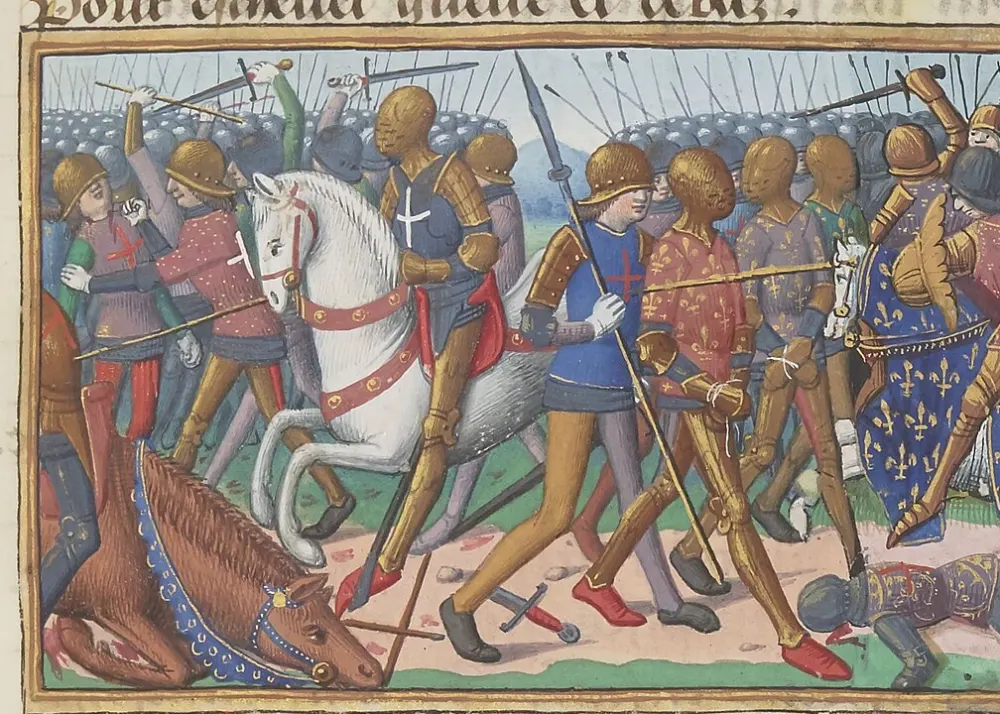
What actually decided it
Choose the width
Standing in a narrow field between two woods limited the frontage to about 750–900 metres. Numbers are only superiority once they have room13.
Make him move first
Build the defensive shape, then advance and provoke with shooting. Waiting alone breaks the hungrier side first13.
Use arrows to raise density
Converging fire pushed men toward the centre. On our reading, density mattered more than the killing34.
Use stakes to delete a reachable place
Not the performance of the weapon but the arrangement in which it works. The repulsed cavalry jammed their own side further4.
Why the losers were not fools
Reading the French as heavily armoured knights charging recklessly to their doom is contrary to the facts. They had brought the lesson of last time. Having watched mounted charges broken by archery at Crécy and Poitiers, they dismounted most of their men-at-arms and confined the cavalry to the flanks of the archers12. The reading was sound.
What broke was not the plan but its premise. "Attack the flank" requires width in which to reach a flank. In a narrow field between two woods there is nowhere to go round. And it was the English who chose the field.
The second thing is the structure of command. Charles VI was absent through illness and the Dauphin was absent too. The constable d'Albret and the marshal Boucicaut held the offices, but the field was full of princes who outranked them socially. It had not been settled who decides. And because the great nobility crowded into the honourable first line, the formation was shaped by precedence rather than tactics12.
Before the battle there was a proposal not to fight at all but to shadow the English and let hunger work: the caution of the experienced. That it did not carry — like Kutuzov at Austerlitz, Paullus at Cannae, Gravina at Trafalgar and Paulus at Stalingrad — is the fifth appearance of that shape on this site.
Which is why the defeat is not someone else's problem. Hold the correct plan and, if the conditions it requires have been chosen by your opponent, the result is the same. And the reason those conditions get chosen for you is usually that nobody has settled who decides.
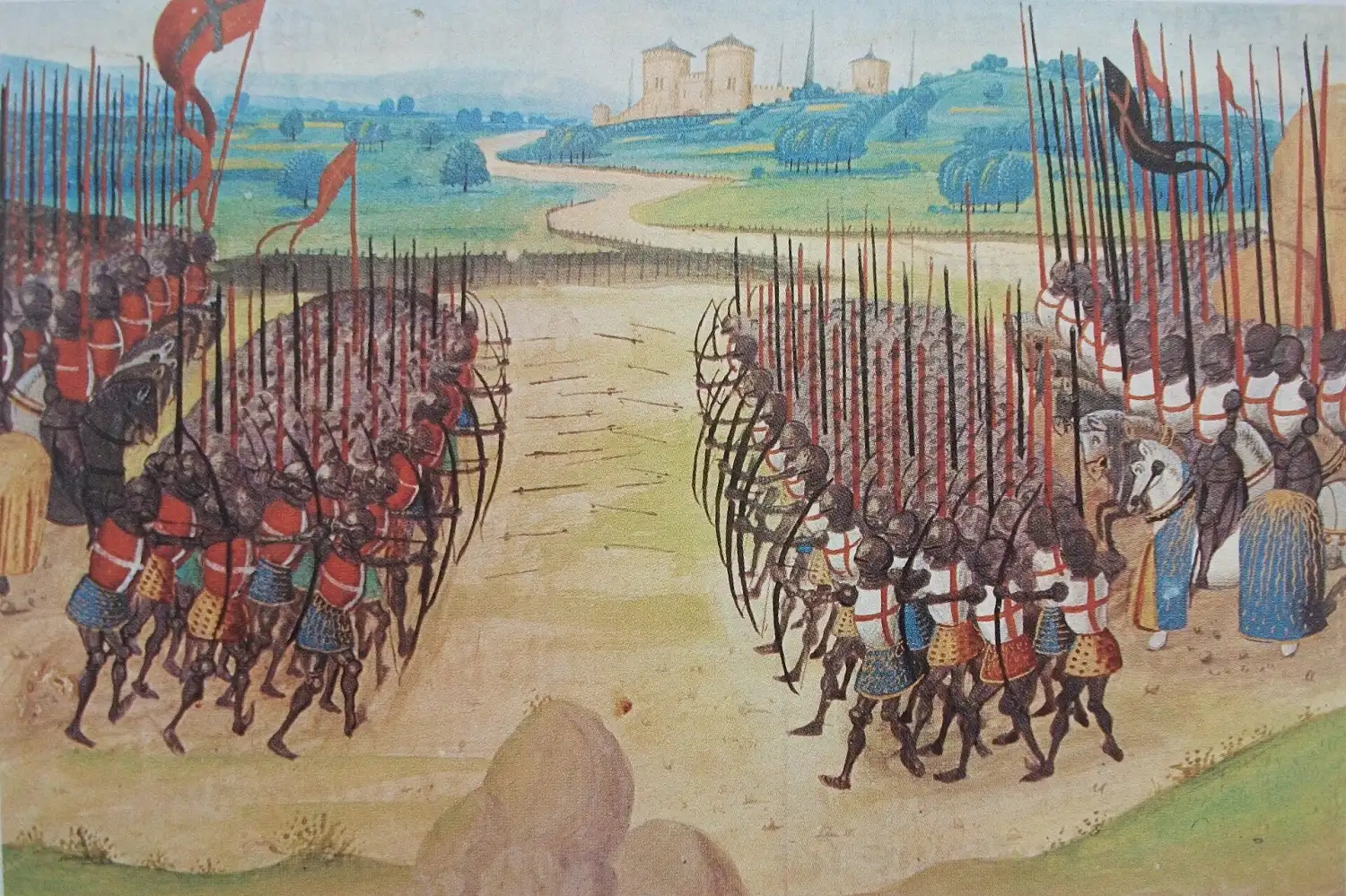
Aftermath — a total victory that depended on the winner's lifespan
The shock was large, and the French higher nobility lost heavily in a single day. Henry went on to conquer Normandy and, by the Treaty of Troyes in 1420, to have his claim to the French succession recognised. So far this looks like a tactical victory converted into a political settlement12.
But Henry died in 1422 at thirty-five. His heir was nine months old, and the arrangement in France lost the man who held it up. The siege of Orléans was broken in 1429; by 1453 England had lost virtually everything on the continent. The completeness of Agincourt did not settle the outcome.12
What Cannae, Trafalgar and Stalingrad showed repeats a fourth time. A decisive victory is decisive only inside its own arena. Here the arena was a single day's battle, and the war was settled by population, finance, and how many years a king lived.
The story — an inflated ratio and the myth of the longbow
Two stories here deserve checking, and both prop up the same single tale: that a few beat many by the power of a weapon.
The first is the ratio. Figures like "6,000 English against 36,000 French" circulated for a long time. Working from the muster records, Anne Curry puts it at roughly 9,000 to 12,000 — about one and a half to one1. Other scholars argue for a much larger gap, and the dispute is not settled23. What matters is not who is right but that the premise of an overwhelming disparity is itself unproven.
Why the numbers grew is no mystery. The winner wants the gap to be large. Contemporary English accounts emphasised it and later ages inherited the emphasis — the same mechanism that swelled the drownings in the frozen ponds at Austerlitz.
The second is the longbow. "The longbow pierced plate armour" is not supported by recent scholarship or by shooting trials. Penetration of good plate was limited; what decided it was the horses, the thin places in the armour, sight and breath — and density34.
The correction matters not as a point about technology. An explanation of the form "the new weapon won" pushes out of view the design that actually told — the choice of width, the provocation, the ground, the control of the formation. It performs exactly the function of the "fateful five minutes" at Midway, "Trafalgar stopped the invasion", and "General Winter" at Stalingrad. Credit one cause with everything and the conditions that let that cause work disappear.
Counterfactuals — remove one factor at a time
A: if the field had been open plain. The French can spread, the cavalry can reach the flanks of the archers, the plan runs as planned, and the difference in numbers simply tells. The first thing settled in this battle was the width.
B: if it had not rained the night before. The advance on foot in armour is not spent before contact and the crowd is not held by the mud; the arrows are less effective too. Nobody designed the ground, and the ground made the design work.
C: if Henry had waited instead of advancing. The French had every reason to wait: it was the English who were starving. A design of frontage produces nothing unless the enemy walks into it.
Each is an untestable thought experiment, not a claim about what was. Only by removing a factor does its weight become visible.
What transfers — in other arenas
Competition: choose ground where scale cannot deploy
Compete in a space too narrow for a large rival to bring people and budget to bear — a specific industry, a specific operating condition. Why this example: numbers are only superiority once they have room.
Negotiation and meetings: narrow the agenda
The wider the set of issues, the more the side with more material to deploy is favoured. Narrow it to one and preparation advantage stops telling. Why this example: settling the width was the first move.
Work out who loses by waiting
In a stand-off, establish which side time hurts. If it is you, manufacture the other side's reason to move. Why this example: Henry advanced because he was the one who could not wait.
Build the arrangement in which a tool works, not the tool
The same tool does nothing where it cannot reach. Stakes were not for killing horsemen but for creating ground horsemen could not reach.
Distrust "the new tool won"
Crediting the technology conceals the conditions that made the technology work. Why this example: the longbow rarely pierced good armour; what it created was density.
In closing — numbers are superiority only once they have room
Summarise Agincourt as a victory of the longbow and you miss the core. Good plate was rarely pierced. What the arrows did above all was push men away from where the arrows came from, and that, combined with a narrow frontage and mud, turned superiority in numbers into a density that could not move.
And choosing the width is not enough. You have to manufacture the reason the enemy comes into it. Henry advanced rather than waited, because he was the one who was starving.
What this case adds to the five already here is a sixth type. Austerlitz was a design of space, Cannae of momentum, Midway of time, Trafalgar of command, Stalingrad of attachment. Agincourt is a design of frontage — limit the battlefield to dimensions in which the enemy's numbers cannot deploy, and get him to walk into it.
One last thing. This type works best when you are the weaker side: the stronger side has no reason to narrow anything. So it reads as a way of manufacturing conditions from a position where you cannot choose them — though what you can choose is only where and when, not what remains after the win. The completeness of Henry's victory depended on how many years he lived.
Frequently asked questions
Sources
- Anne Curry, Agincourt: A New History, Tempus (2005)
- Juliet Barker, Agincourt: The King, the Campaign, the Battle, Little, Brown (2005)
- Clifford J. Rogers, The Battle of Agincourt (in 'The Hundred Years War, Part II: Different Vistas'), Brill (2008)
- Matthew Strickland, Robert Hardy, The Great Warbow: From Hastings to the Mary Rose, Sutton (2005)
Related cases — read in comparison