Normandy: making the real thing look like the fake
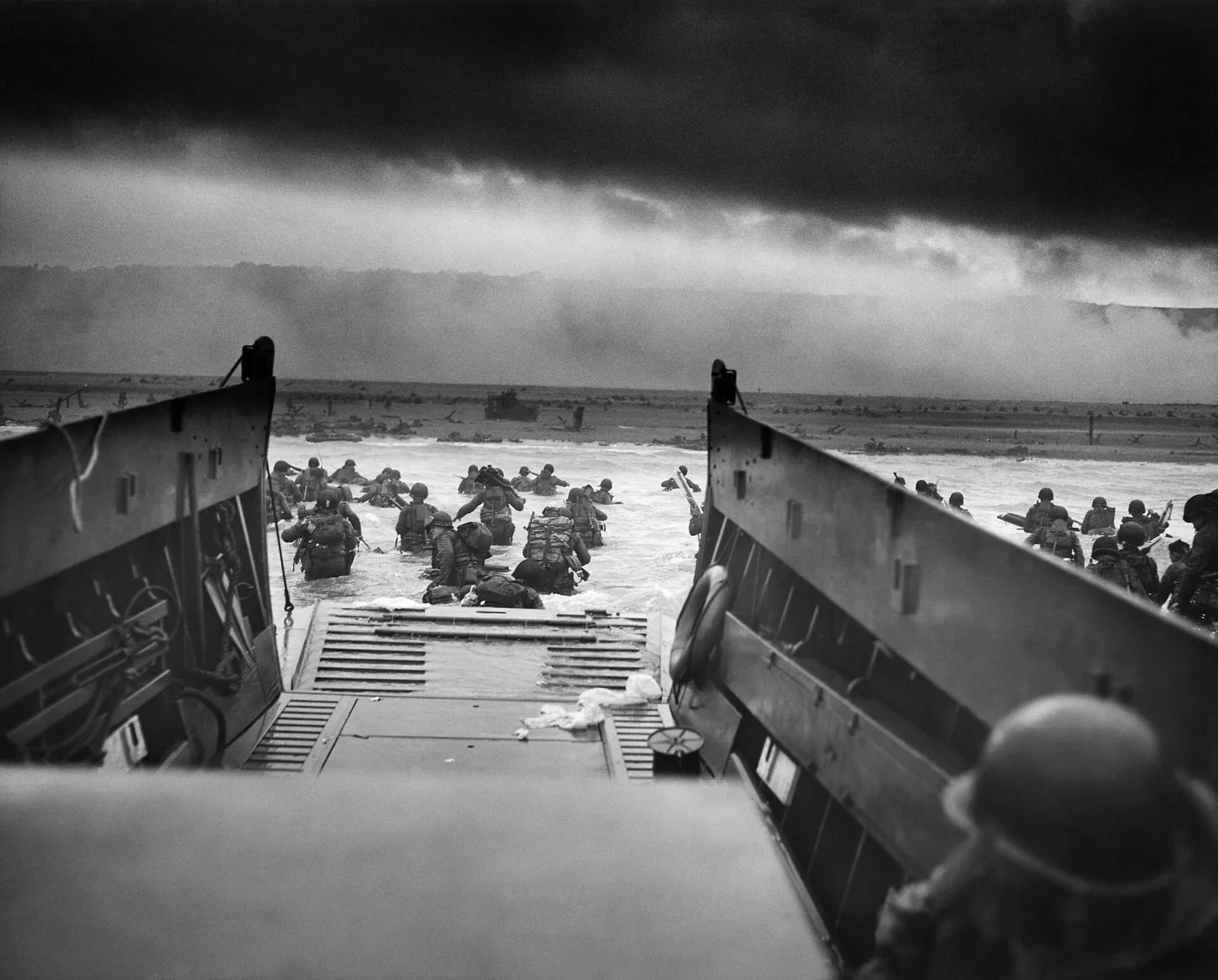
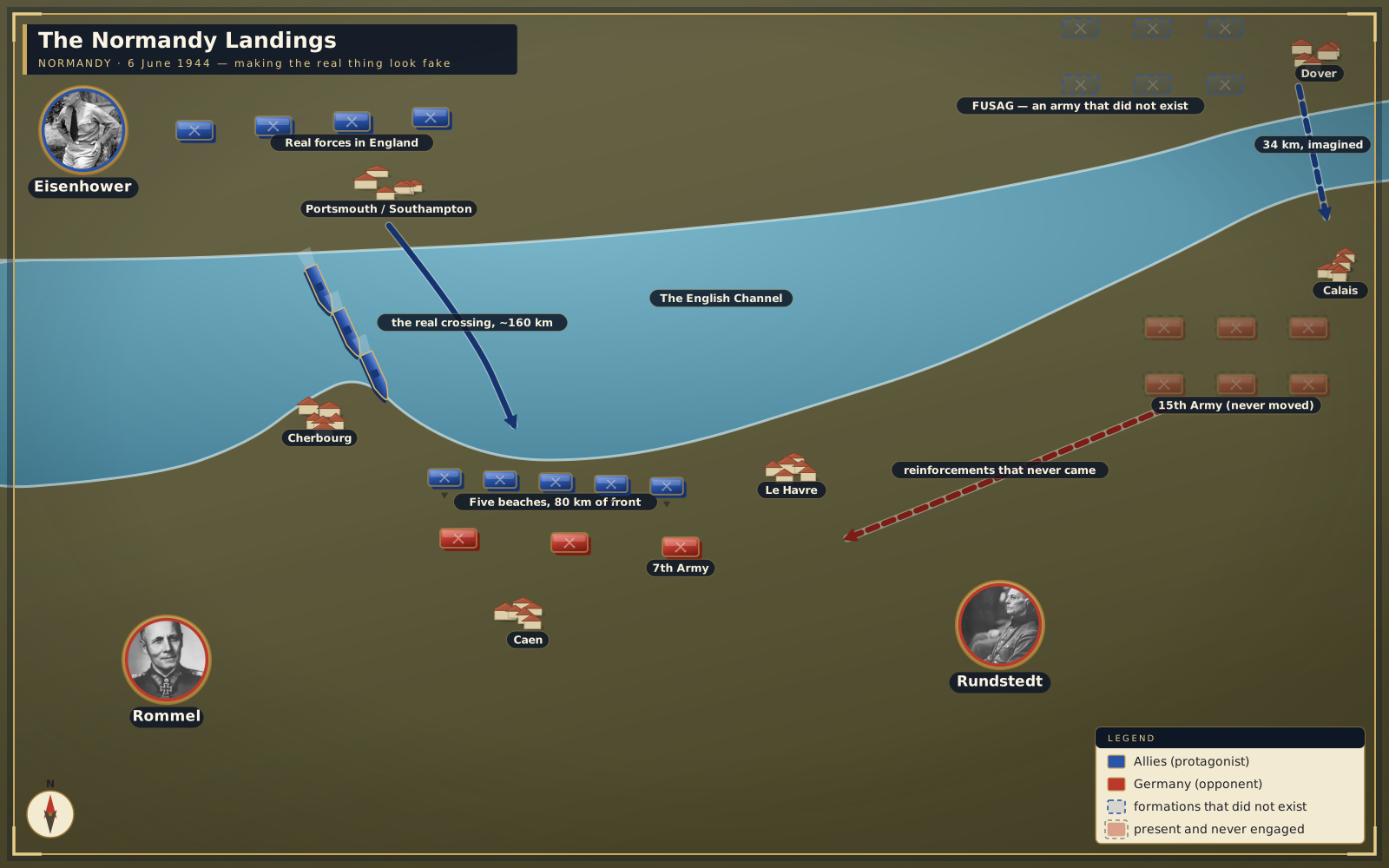
6 June 1944. About 156,000 men came ashore across 80 km of coast. But the most important part of the operation is not that they landed. It is that for about 7 weeks afterwards the German command went on believing the real blow was still to fall at Calais. The deception did not hide the landing. It made the landing look like the fake.
- The aim was not surprise. It was to keep the enemy reading the landing as a diversion after it had happened — a real event consumed as evidence for a fiction.
- The rubber tanks are the wrong memory. By 1944 the Luftwaffe could barely photograph England; the lie travelled through double agents the enemy believed were his own network.
- The German Fifteenth Army in the Pas-de-Calais was real, and stayed still for about seven weeks. An army that did not exist pinned one that did.
Pattern: a design of deception →
The protagonist is shown in blue, the opponent in red.
- Date
- June 6, 1944
- Place
- The Normandy coast, northern France (Calvados and Manche)
- Key figures
- 4
- Result
- Allied landings succeed
Contents
- Background: the correct guess was the narrowest crossing
- Divisions in Britain: the German count and the real one
- Normandy in numbers
- Deployment: an army group that did not exist, and an army that did not move
- The claim: the deception did not hide the landing — it made the landing look fake
- Two layers: what happened, and what was designed
- How it went: 1944
- What actually did the work
- The losing side was not stupid
- A lie needs a line that tells you it was believed
- Result: not that they got ashore, but that they kept coming ashore
- The story: rubber tanks
- Counterfactuals: remove one element at a time
- What carries over: on other ground
- In closing: sometimes the real thing looks like the fake
Background: the correct guess was the narrowest crossing
By 1944 the German command knew the Allies were coming across the water. The question was where.
And they reasoned soundly. The Pas-de-Calais is where England and France come closest — 34 km of water. Fighter cover reaches it easily, and from there the industrial Ruhr is close. The V-1 sites were there too. So the Atlantic Wall was thickest at the Pas-de-Calais. This was not a foolish conclusion. The Allies had considered the same ground first.
What they chose instead was further away and less convenient: Normandy, a crossing of some 160 km — more than four times as far — with no port at the far end, which is why they took harbours with them.
That fixed the job of the deception plan, Fortitude. It did not need to overturn the German reasoning. It needed to confirm it.
Divisions in Britain: the German count and the real one
The gap between 75 and 50 is not simple over-estimation. The difference existed in German hands as a roster of formations that were not there — with numbers, commanders and locations. The man who sent that order of battle days after D-Day was a double agent run from London5.
Normandy in numbers
| Allies (protagonist) | Germany (opponent) | |
|---|---|---|
| Landed on 6 June | about 156,000 men (of which airborne about 24,000) | — |
| Width of the landing front | 80 km | the whole Atlantic Wall |
| Aircraft on the day | 9,543 | 815 |
| Confirmed dead on the day | 4,414 | — |
| Divisions in Britain (as the enemy held it) | 75 (actually about 50) | — |
| Held facing the Pas-de-Calais | — | 2 armoured, 19 infantry |
| How long that lasted | — | about 7 weeks |
The 9,543 to 815 figure is for the air over Normandy that day, but the ratio explains this case's premise. By 1944 the Luftwaffe had almost nothing left with which to photograph England14.
Deployment: an army group that did not exist, and an army that did not move
The centre of Fortitude South was an army group: the First United States Army Group (FUSAG). Commander, Patton. Assembly area, Kent and Essex. Objective, the Pas-de-Calais. Of those, only Patton was real.
On the German map this was the strongest striking force in Britain. Which meant that on their arithmetic, even after adding up everything ashore in Normandy, the main body was still in England.
Directly opposite it stood the Fifteenth Army, holding the Pas-de-Calais. That one was real. 2 armoured and 19 infantry divisions. For about 7 weeks after the landing, it stayed where it was and did not go to Normandy25.
Put the two side by side and the case has its shape. An army that did not exist pinned an army that did.
The claim: the deception did not hide the landing — it made the landing look fake
Deception is usually imagined as not being noticed. That was not Fortitude's aim. You cannot hide 156,000 men coming ashore across 80 km of coast, and nobody tried.
What was designed was what came next. The landing happens, the enemy sees it, the reports go up. And a place has already been prepared in his head to put them: the place labelled "the diversion that comes before the real thing".
So 6 June arrived on the German side not as a surprise but as a confirmation. The diversion had come, as expected. A real event was consumed as evidence for a fiction.
This is the tenth type: the design of deception. It looks close to the lure at Austerlitz and is not the same thing. What Napoleon built was a misunderstanding about one hill on one day, and it was corrected the moment the counter-attack began. What Fortitude built was a frame to file misunderstandings in — and it survived the event that should have destroyed it.
It is also the mirror of Midway. There the Americans read the enemy's plan. Here the Allies wrote its premise.
The deception did not hide the landing. It made the landing look like the fake.
The claim
Two layers: what happened, and what was designed
Dummy craft and vehicles were laid out in south-east England.
The Germans held that Britain contained 75 divisions.
The number arrived through channels they believed were their own. A lie only travels when it reaches the target as something he found for himself.5
On 6 June a landing took place in Normandy.
The German frame could file it as "the diversion before the main blow". When the frame comes first, the evidence is read to fit it.
How it went: 1944
The Bodyguard framework is settled. Fortitude is its western part, split between the north (Norway) and the south (the Pas-de-Calais)12.
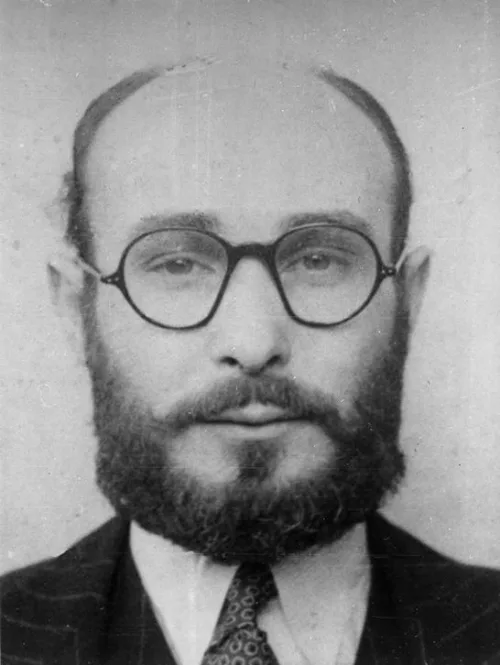
FUSAG's wireless traffic and order of battle are built. In parallel the double agents keep reporting; GARBO alone sends over 500 wireless messages5.
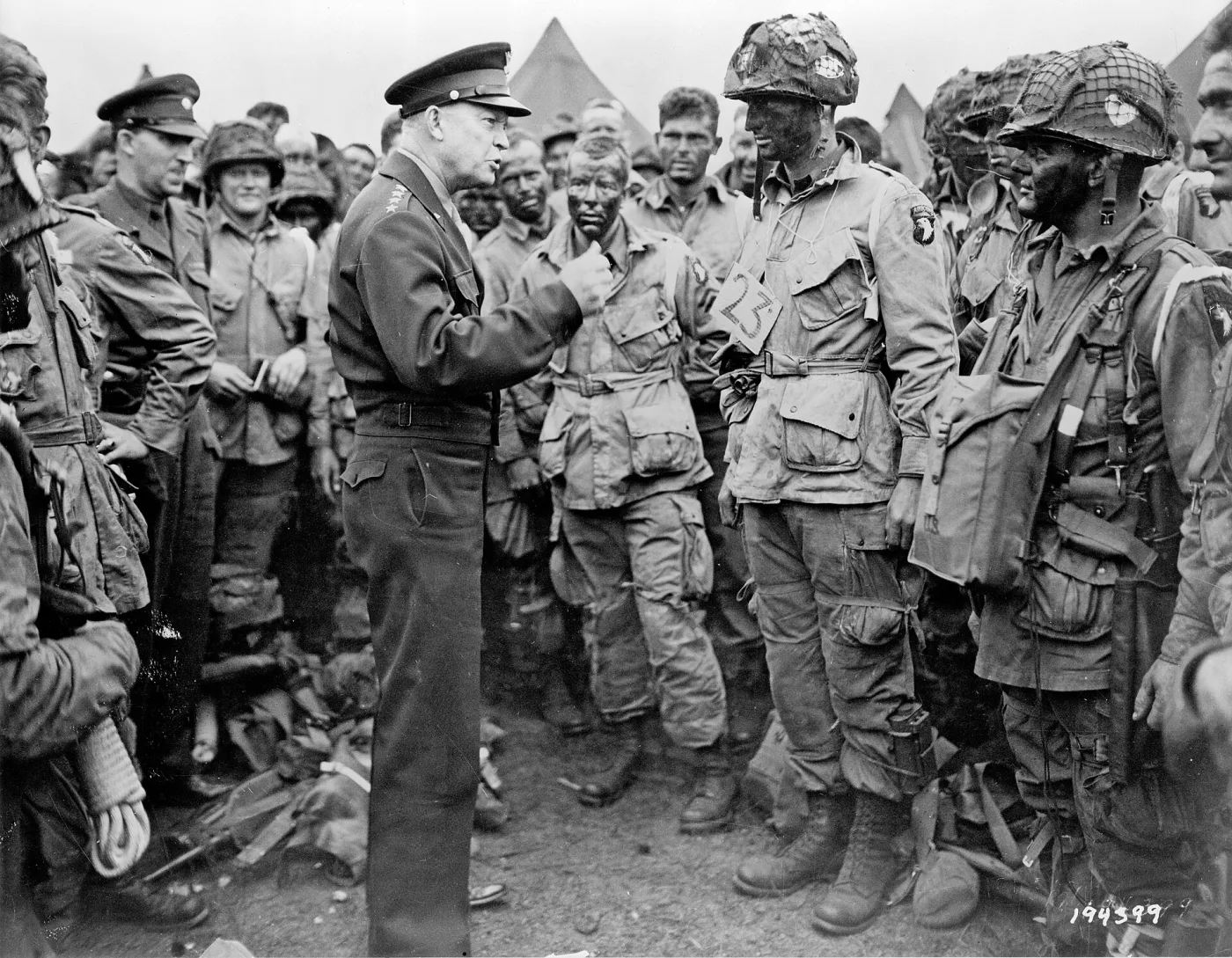
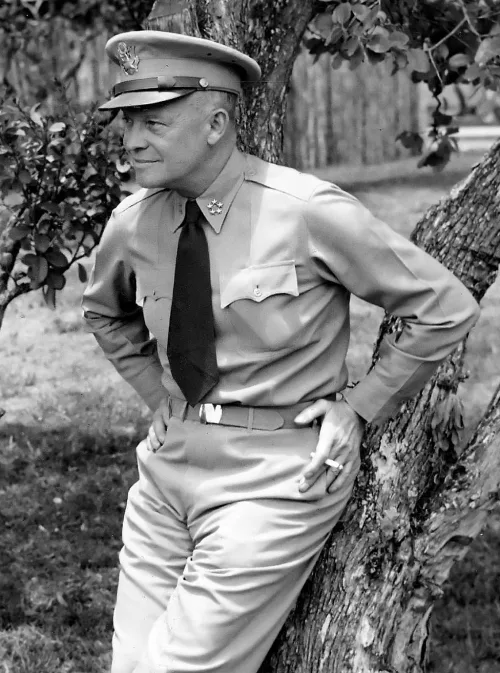
Eisenhower orders the landing and writes the statement for failure, putting it in his jacket. Rommel is in Germany4.
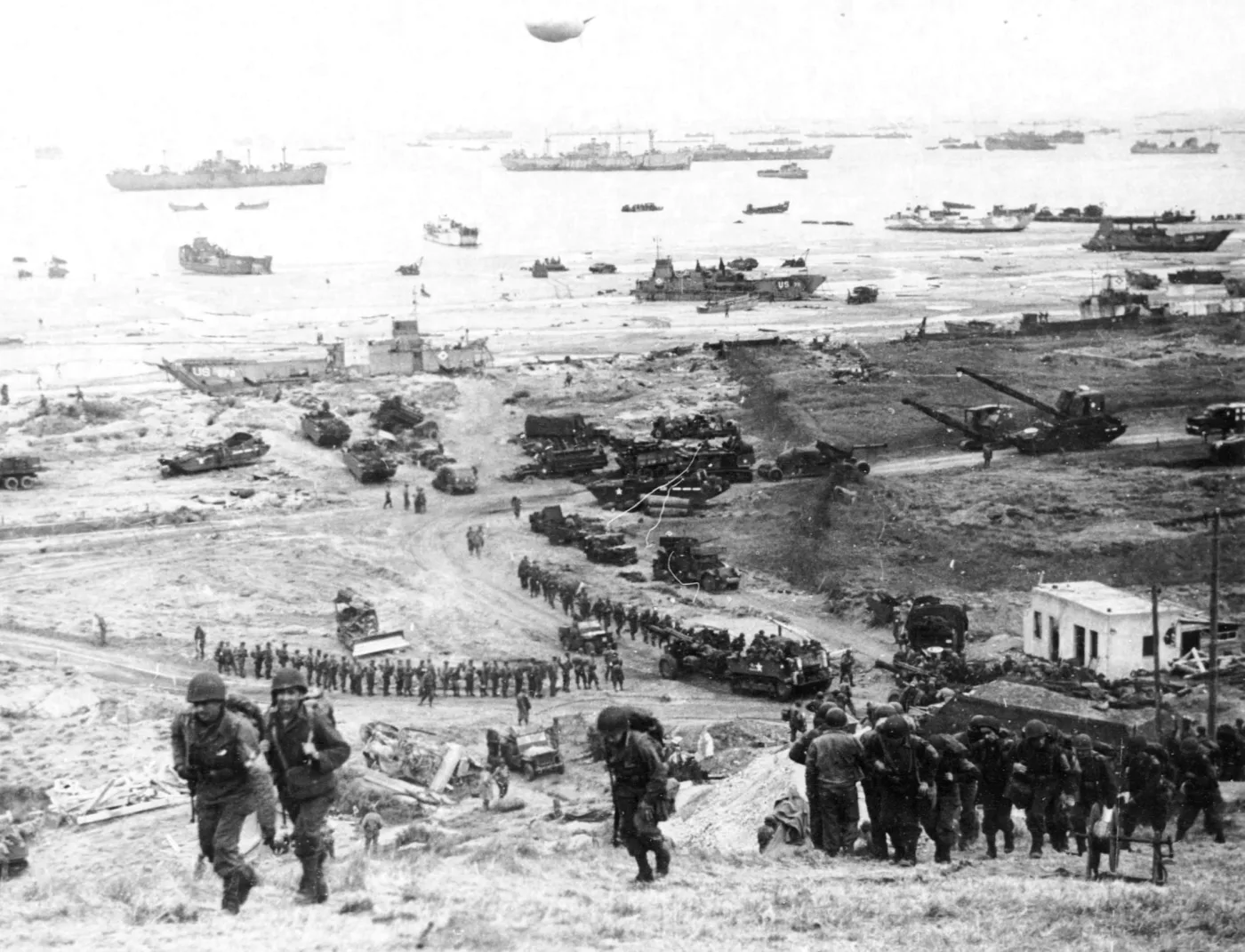
About 24,000 airborne troops drop. The landings begin: about 156,000 men across 80 km of coast4.
Part of the armoured reserve waits on Hitler's release and is not freed until the afternoon4. Confirmed Allied dead for the day: 4,414.
GARBO signals Berlin. Britain holds 75 divisions and FUSAG has not moved — therefore the first landing should be treated as a diversion5.
The force facing the Pas-de-Calais does not move. It grows. Reportedly there were more German troops there at the end of June than on the day of the landing35.
GARBO is awarded the Iron Cross. While a deception is working, the other side still believes it is right.
Divisions of the Fifteenth Army finally start moving to Normandy. Bridges and railways have been cut from the air, and the movement itself takes weeks4.
The same man receives the MBE from Britain. Both countries decorated him for the same work.
What actually did the work
Confirm the enemy's reasoning instead of contradicting it
The Pas-de-Calais was a German conclusion, not an Allied invention. The cheapest lie is one that agrees with what is already believed.
Deliver it through a channel he trusts
The dummies did not do it. Communications the enemy believed were his own network did15.
Keep a line that tells you whether it is believed
Code-breaking showed German decisions moving in step with the false order of battle. A lie whose replies you cannot read is only a bet.12
Design how the real event will be read
The landing was not hidden; it was classified as the diversion. A lie lives exactly as long as it can absorb the evidence against it.
The enemy must be able to afford a reserve
The Fifteenth Army could sit still because Germany could hold it back and still fight. An enemy with no reserve cannot be pinned.
The losing side was not stupid
Reading the German command as gullible does not fit the record. Their inference was sound, and so was their defensive doctrine.
Rundstedt's rule — hold the armoured reserve concentrated inland, commit it once the main landing is identified — is textbook. Avoiding piecemeal commitment is correct. But the rule carries a premise: that the main landing will be identified. That premise was an enemy product. Feed a sound rule a false input and it yields the worst answer available. What broke here was not judgement but the material judgement was made from.
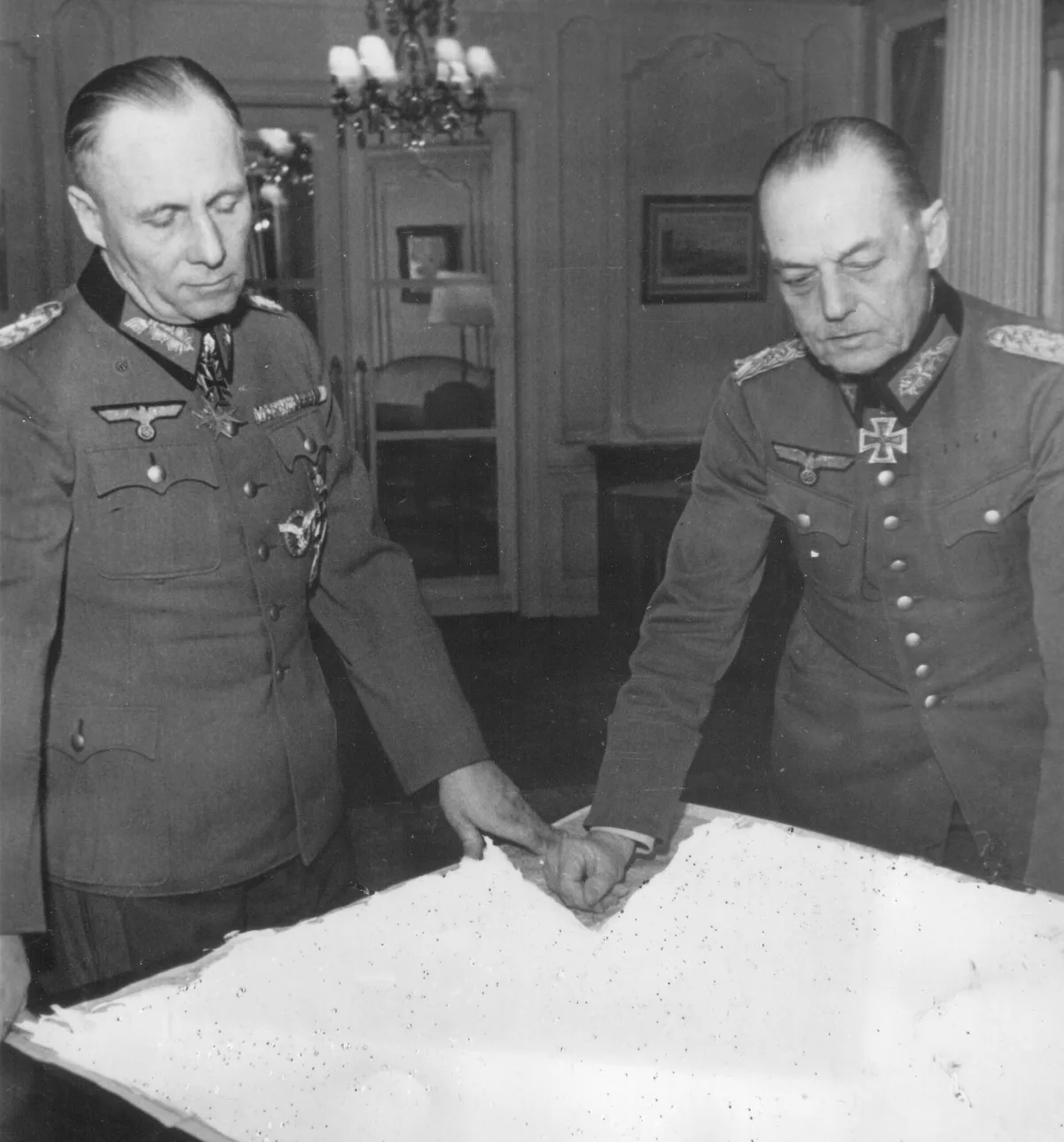
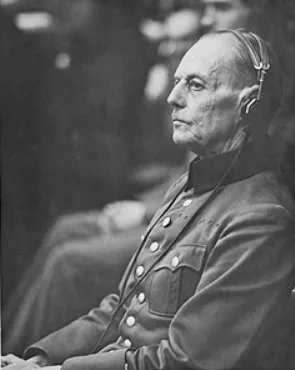
Rommel read it differently. A side without air control cannot bring reserves up from inland, so a landing must be stopped at the water's edge inside twenty-four hours — put the panzers immediately behind the beaches4. Post-war assessment has largely agreed. He did not get it adopted. And on 6 June he was in Germany, because the tide and weather tables ruled a landing out.
A correct reading losing to a structure now appears here for the ninth time: Kutuzov at Austerlitz, Paullus at Cannae, Gravina at Trafalgar, Paulus at Stalingrad, Boucicaut at Agincourt, Gérard at Waterloo, Pemberton at Vicksburg, Mitsunari at Sekigahara. This time the variant is "the input to the judgement was manufactured by the enemy". Vicksburg had two superiors; Sekigahara had none. Here there were superiors — and the map they were reading was written by the other side.
A lie needs a line that tells you it was believed
The most overlooked part of this case is that the Allies knew the lie was working.
Because German ciphers were being read, they could watch their double agents' reports flow into German assessments. They could see the fabricated order of battle being copied onto the enemy's own operations map12.
This is a structural point rather than a technical one. Deception cannot be designed one-way. Without a return signal, the sender never gets past "probably working". Continuing a lie that has failed and abandoning one that is succeeding are equally fatal.
So the type has two conditions: a channel the target trusts, and a way to read his reaction. With only the first, it is not deception; it is hope.
Result: not that they got ashore, but that they kept coming ashore
The landing of 6 June was in itself neither success nor failure. A beachhead pushed back into the sea is not a beachhead. Confirmed Allied dead for that single day come to 4,414.
The decision was made in the weeks that followed. The Allies put men and stores ashore every day. The Germans did not use the reserve that stood nearest. When that asymmetry had accumulated, the beachhead was a front.
The structure of Vicksburg is here too: the decision happened along the line things flow down, not in the battle. The difference is that Vicksburg cut the enemy's line, while Normandy protected its own by freezing the enemy's reinforcements.
The story: rubber tanks
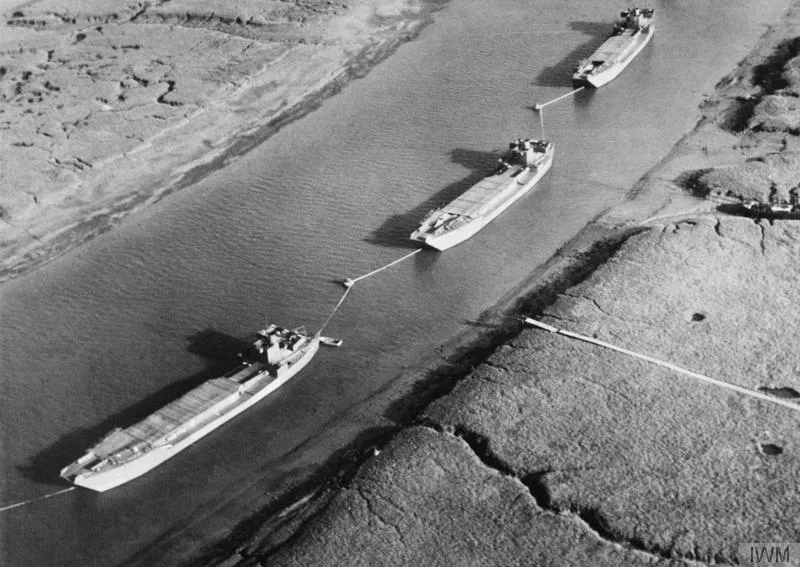
The popular memory of the operation is rubber tanks and plywood landing craft fooling German reconnaissance. It films well, models survive, and there are photographs.
The scholarship reads differently. Nobody came to look. By 1944 the Luftwaffe had almost no capacity to run reconnaissance over Britain, and most of the decoys were never photographed by anyone. They also blew over in the wind12.
What did the work was paper and radio. Give fictional formations numbers, run their wireless traffic, have double agents report them. GARBO alone: 315 letters and over 500 wireless messages. Clerical work, done so that the enemy would feel he had found it himself.
This gives the site its fourth kind of story correction. There is the inflated kind (the frozen lake at Austerlitz), the missing kind (Vicksburg dropping out of view altogether), and the compressed kind (Sekigahara folding months into one man's decision). Normandy is the substituted kind: a photogenic device took the memory slot belonging to the one that worked.
The reason is simple. A rubber tank photographs; clerical work does not. The same mechanism that lost Vicksburg its digging appears here in another form. What is remembered has nothing to do with what worked.
Counterfactuals: remove one element at a time
A: without the double-agent network. The dummies and the wireless traffic remain, but there is no trusted channel. The Germans would still have watched the Pas-de-Calais on their own reasoning, but they would probably not have reached the conviction that Normandy was a feint. The pinning is shorter.
B: without code-breaking. The lie can still be sent. Whether it is landing is unknown. The scale and timing of the landing would have been chosen on hope rather than knowledge. Half of this type sits at the receiving end.
C: if the Germans had held no reserve. There is nothing to pin. The type works only against an enemy who can afford to keep something back. Against an enemy with nothing spare, there is nothing to freeze.
These are unverifiable thought experiments, not claims about what happened. Removing one element is how you see what it weighed.
What carries over: on other ground
Look for what the other side already believes
The cost of persuasion jumps when you have to change a mind. Confirming one is cheap. Ask for their conclusion first.
Design the channel, not just the message
The same content lands differently depending on whether it arrives as something they found themselves. Where it is heard from matters more than what is said.
Build the measurement line before you start
An initiative that broadcasts and cannot read the response can never be stopped or continued on evidence. A plan with no return channel is not a plan.
Count the memorable and the effective separately
What goes into the report is what photographs. Ask every time whether your account of success is being set by what was easy to picture.
List the other causes of the same result
Here the interdiction campaign pushed in the same direction. Give one factor all the credit and you will not understand why the move fails next time.
In closing: sometimes the real thing looks like the fake
Read Normandy as "the largest amphibious operation in history" and you miss the centre. Whether you can get ashore is a question about that day's gunfire. Whether getting ashore keeps meaning anything was a question about how many days the enemy would decline to take it seriously.
And they declined not because they were fools. They declined because that is what their map said. The map had been written by the Allies.
That makes ten. Austerlitz — the design of space; Cannae — absorbing momentum; Midway — the design of time; Trafalgar — the design of command; Stalingrad — the design of fixation; Agincourt — the design of frontage; Waterloo — the design of junction; Vicksburg — the design of supply; Sekigahara — the design of defection. Normandy shows the design of deception: confirm what the enemy already believes, and the real thing will look like the fake.
One last thing. The frightening property of this type is that while it is working, nothing looks wrong from the inside. The Germans were being careful, following the rule, holding their reserve. What was wrong was not the judgement but the map the judgement stood on. No age has ever supplied a reliable way to find out who wrote your map.
Frequently asked questions
Sources
- Michael Howard, British Intelligence in the Second World War, Volume 5: Strategic Deception, HMSO (1990)
- Roger Hesketh, Fortitude: The D-Day Deception Campaign, Overlook Press (2000)
- Thaddeus Holt, The Deceivers: Allied Military Deception in the Second World War, Scribner (2004)
- Antony Beevor, D-Day: The Battle for Normandy, Viking (2009)
- Ben Macintyre, Double Cross: The True Story of the D-Day Spies, Bloomsbury (2012)
Related cases — read in comparison