Person
Dwight D. Eisenhower
Supreme Commander, Allied Expeditionary Force
Life: 1890–1969
The supreme commander who bet on an enemy belief and wrote the failure statement before the landing.
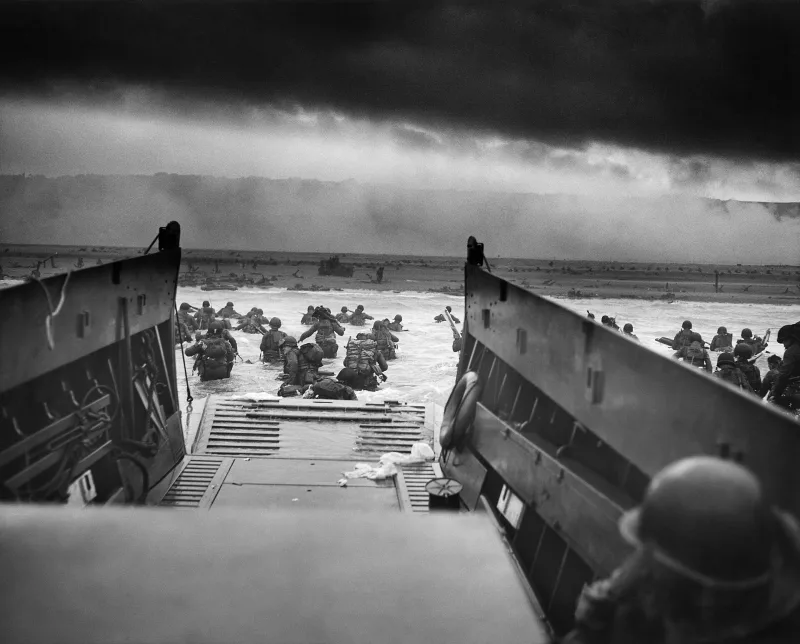
Remembered less as a battlefield commander than as the man who kept a multinational, multi-service headquarters working without breaking. At Normandy he decided knowing that the operation depended on the enemy continuing to believe the main blow would fall elsewhere. On 5 June he ordered the landing and, in the same hours, wrote the statement for failure and put it in his jacket. He settled how a loss would be carried before placing the bet.
Strategic signature — build the shape that removes the need to decide
Eisenhower is not remembered as a brilliant field commander. He is the man who held an alliance's armies, navies and air forces in one headquarters and kept building the arrangement in which nobody had to walk out. He did not invent operations; he built structures in which operations did not break.
The same shows in the decision itself. On 5 June the weather was marginal. He ordered the landing and, at the same time, wrote the statement for failure and put it in his jacket: the landings had failed, and the fault was his alone. Before betting, he settled how a loss would be carried.
Recurring patterns
Make not breaking the coalition the job
He designed the shape of the headquarters so that the operation ran even when British and American generals disliked each other.
Write down how failure will be carried, first
The failure statement was written in advance. When responsibility is already assigned, judgement does not soften halfway.
Accept a lie as part of the plan
The deception was not an addition; it was a premise of the landing plan. The commander owned the fact that his operation rested on one.
Strengths and weaknesses
Can hold a multinational, multi-service chain of command together.
When holding it together becomes the aim, the best tactical option is not always the one taken; his handling of the campaign after the landing was often a compromise.
Can decide knowing the condition of success is a belief held by the enemy.
When that belief breaks is not his to choose. The 7 weeks after the landing were a gift he could not have guaranteed.
Where the signature showed — Normandy
Some 156,000 men landed that day. What gave the operation room was not that number but an army group that existed only on the enemy's map. Where Nimitz at Midway read the enemy's plan, here the Allies wrote its premise.
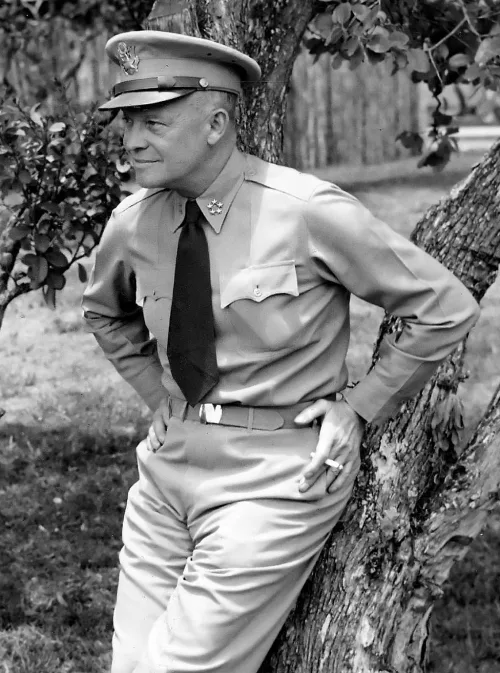
Dwight D. Eisenhower, General of the Army, 1940s, US Army photograph. Public Domain, via Wikimedia Commons
Appears in