The Battle of Midway (1942)
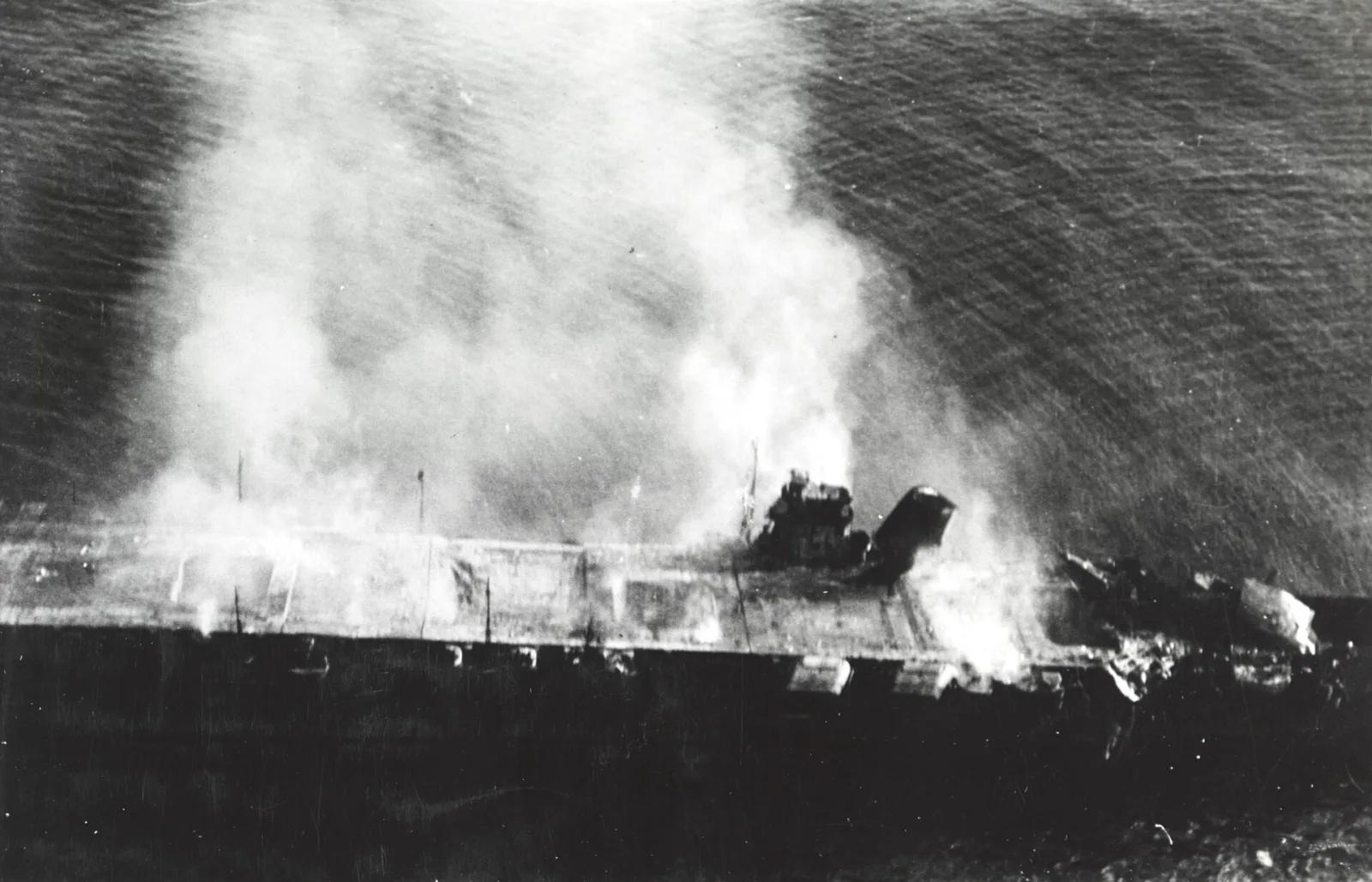
In June 1942, in a battle fought over an atoll of a few square kilometres, the Japanese navy lost 4 fleet carriers in a single day. The Americans had read the plan in advance. But what decided it was not the knowing — it was whether that knowledge could be converted into time taken away from the enemy's flight decks.
- American codebreakers fixed both the target and the date, and three carriers were placed outside the Japanese search arcs. The intelligence had closed the gap in strength before the battle began.
- The decisive factor was that successive attacks denied the Japanese the 30–45 uninterrupted minutes a full deckload strike required. The torpedo squadrons that were wiped out were taking exactly that time.
- The famous "five minutes from launching" scene does not match the Japanese primary records: what stood on the decks around 10:20 was mainly the defensive fighter patrol, not a spotted strike.
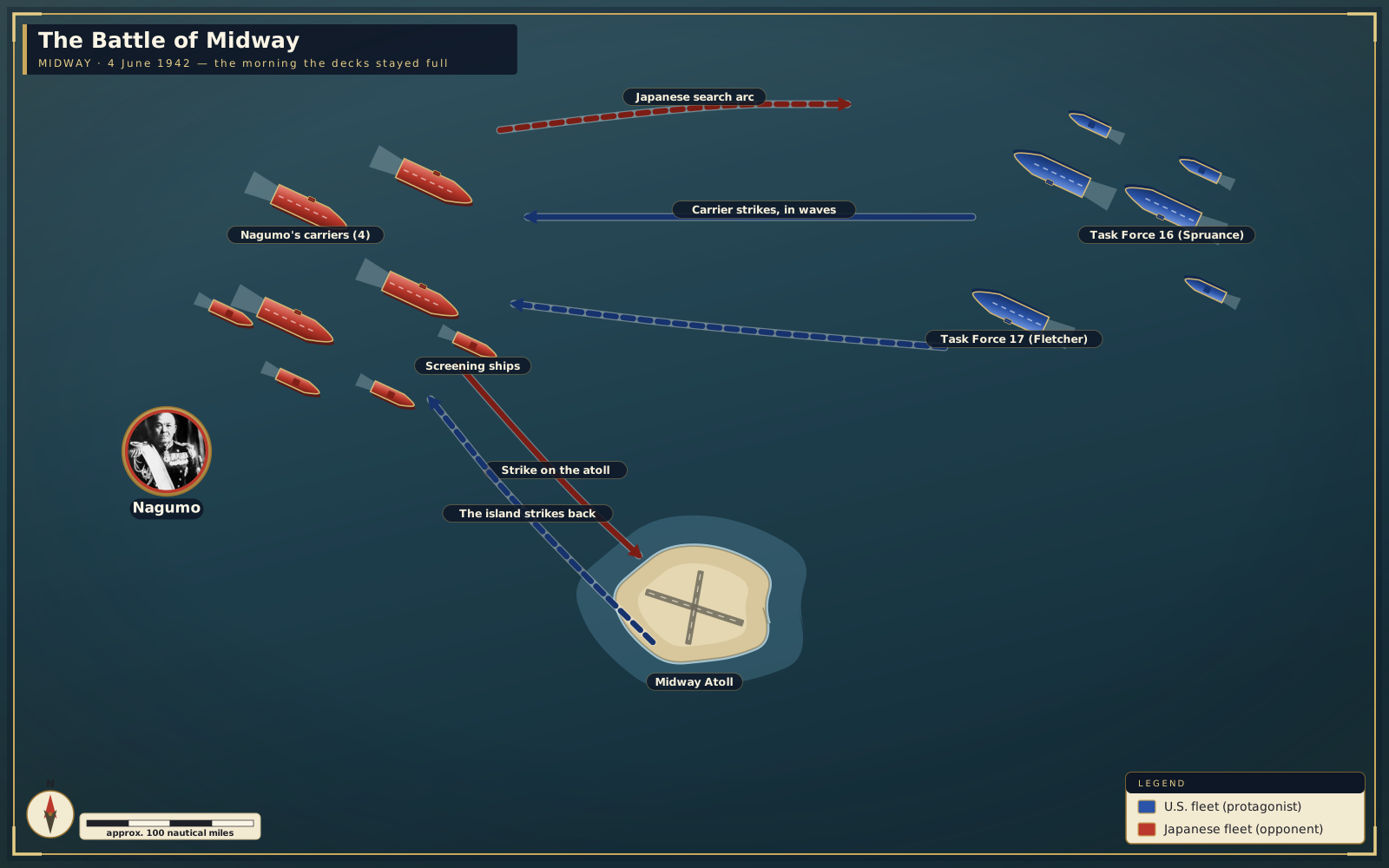
The protagonist is shown in blue, the opponent in red.
- Date
- June 4, 1942
- Place
- Off Midway Atoll, North Pacific
- Key figures
- 5
- Result
- Decisive American victory
Contents
- Background — why an atoll of a few square kilometres
- Forces — the numbers favoured Japan
- Deployment — the fourth flight deck, the one that could not sink
- Thesis — intelligence wins only when it becomes the enemy's lost turn
- Two layers — the surface fight and the design beneath
- The course — 4 June 1942
- What actually decided it
- The defeat — the Japanese were not fools
- Losses compared
- The story that grew — the "fateful five minutes"
- Counterfactuals — removing one factor at a time
- What transfers — beyond the sea
- In closing — can you turn knowing into time?
Background — why an atoll of a few square kilometres
In the first half of 1942 Japan was winning. Six months after Pearl Harbor the southern resource area was largely taken and the carrier force had ranged as far as the Indian Ocean. But continuing to win is not the same as being able to end a war. For Yamamoto, who knew the industrial arithmetic, time was always on the other side23.
In April, sixteen B-25s flown off a carrier bombed Tokyo. The material damage was slight. What the raid demonstrated was a hole in the defensive perimeter — and, more to the point, that the American carriers were still alive. The problem was not the damage but the visibility of the fact. Yamamoto moved to push the perimeter east and, in the same operation, draw out and destroy those carriers23.
The bait chosen was Midway atoll: a few square kilometres some 2,000 km north-west of Hawaii, valuable not in itself but because the Americans could not decline to defend it. Choosing a target the enemy cannot abandon is a sound way to force him out. The design depended on exactly one thing: that he did not know the plan12.
That one thing had already failed. In a basement at Pearl Harbor, Rochefort's unit was reading enough of the Japanese naval code to assemble the outline of the operation by mid-May. The trap was laid; but which side was setting it, and which was waiting, had begun to change places23.
Forces — the numbers favoured Japan
These are the forces that met. Japan also sailed battleship and invasion groups, but they were too far away to take part. On the American side roughly 115–127 land-based aircraft on Midway itself must be added12.
Deployment — the fourth flight deck, the one that could not sink
Sea battles have no terrain in the way land battles do. This one had two things that served the same purpose: the atoll, and the difference between seeing and not seeing.
Midway had runways, patrol aircraft and bombers. For the Americans the island counted as a flight deck that could not be sunk. Three carriers plus an island bring the air arithmetic close to even. The first attacks on the Japanese force on the morning of 4 June came not from carriers but from the atoll. They scored almost nothing — and burned Japanese fighters, ammunition and, above all, deck time12.
The second kind of terrain was position. Nimitz placed his three carriers north-east of Midway, outside the Japanese search arcs, on the flank of an enemy heading for the island. "Point Luck" is nothing but a coordinate. Being able to occupy it was entirely a product of knowing when and where the enemy would come. That is what the conversion of intelligence into position looks like23.
Japanese search was thin. Reconnaissance was treated as a deduction from striking power, and some seven aircraft divided a very large arc; one of them launched about thirty minutes late. Economising on looking is billed in full at the moment you needed to see. The bill arrived that morning1.
Thesis — intelligence wins only when it becomes the enemy's lost turn
Midway is usually explained in a sentence: the Americans had broken the code. True — and it skips the part that matters. Between knowing and winning there is a conversion.
The conversion here comes to one thing. Nagumo was never given an unbroken block of time in which to spot and launch a counterstrike. Putting a full deckload into the air required lifting aircraft from the hangars, spotting them, warming up and launching: on the order of 30–45 clear minutes, across all four decks at once, during which the decks are full and the defensive fighters can neither land nor take off1.
Through the morning the Americans sent in the island's bombers, then torpedo squadrons, then dive bombers — separately, and one after another. This was not a co-ordinated simultaneous attack; it was the result of an attack that failed to co-ordinate. And that raggedness is precisely what kept taking Nagumo's time away. The very thing that made the American strike inefficient made it effective at stopping the enemy's procedure.
That is the structure of this case. Information superiority scores no hits by itself. It becomes a result only when it is converted into operations that eat the opponent's decision and preparation time. What knowing is worth is measured in how many turns you take from the other side.
Broken codes do not win battles. They win when they are converted into minutes the enemy never gets to clear his deck.
Thesis
Two layers — the surface fight and the design beneath
The American torpedo squadrons were annihilated without scoring a single hit.
Nagumo ordered the armament changed twice and is remembered as hesitating.
By the practice of the day it was the reasonable sequence for a commander holding two tasks. The problem was not decision speed but that the sequence presumed continuous time1.
Dive bombers set three carriers alight within minutes.
The American carriers launched at extreme range and lost many aircraft.
They chose arriving in time over waiting for certainty. The losses were the price of that tempo2.
The course — 4 June 1942
Nagumo launches about 108 aircraft against Midway, and seven search aircraft. One of them, from the cruiser Tone, gets away roughly thirty minutes late1.
An American PBY sights and reports the Japanese carriers. The Americans have the enemy's position before the enemy has theirs2.
Midway is bombed; the island's aircraft strike back at the Japanese force, scoring almost nothing and suffering heavily. The strike leader reports that a second attack on the atoll is needed1.
With no American ships in sight, Nagumo orders the reserve aircraft re-armed from anti-ship to land-attack weapons13.
The Tone aircraft reports American ships, at first without saying what they are; a carrier is confirmed only around 08:20. Nagumo halts the re-arming12.
The torpedo squadrons arrive in succession. VT-8 loses all fifteen aircraft with one survivor; VT-6 and VT-3 lose most of theirs. No hits. But the Japanese fighters are drawn down low and the carriers keep manoeuvring12.
Into an emptied upper air come the dive bombers of Enterprise and Yorktown. Within minutes Akagi, Kaga and Sōryū are burning12.
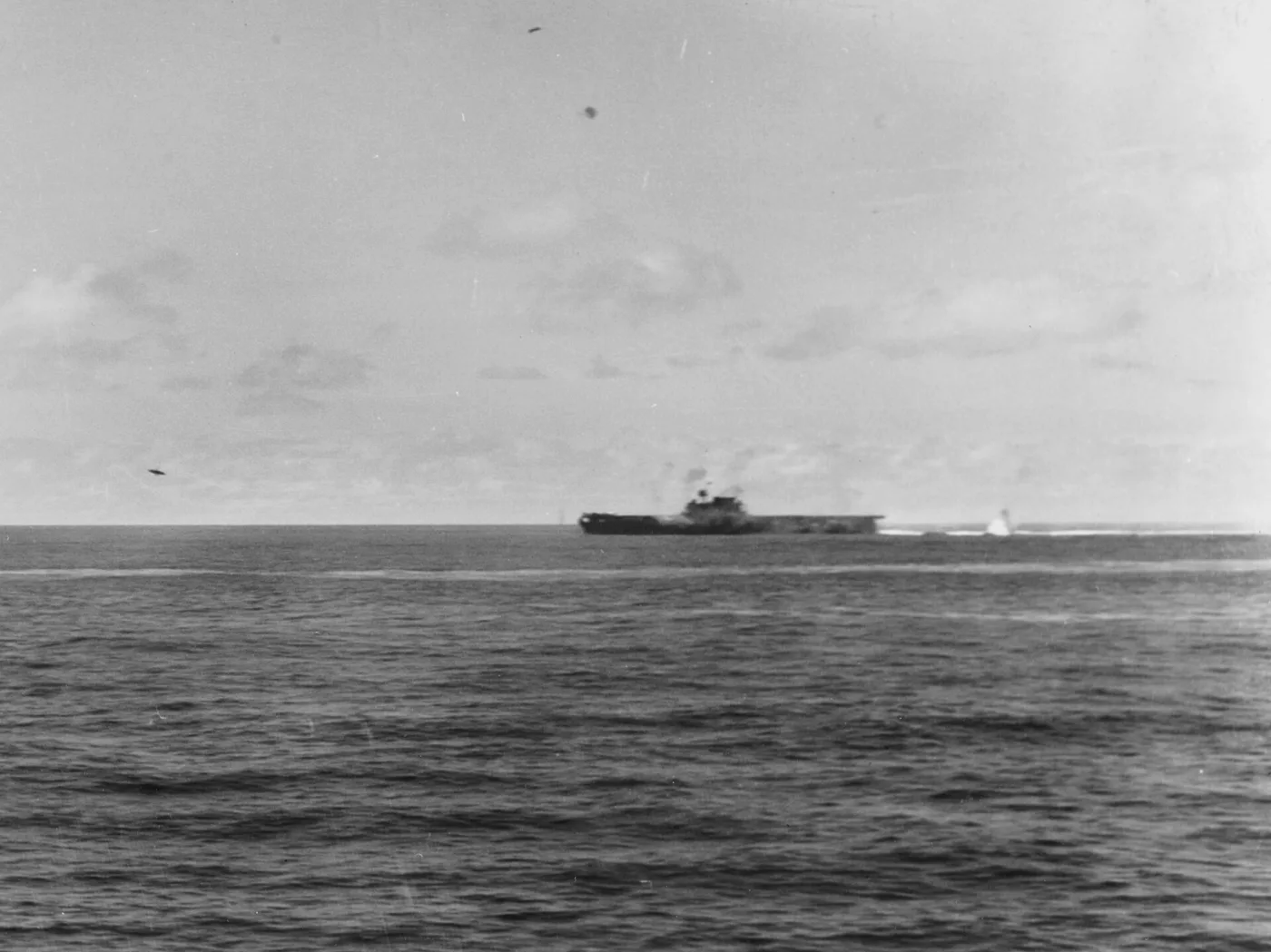
The surviving Hiryū launches two strikes and wrecks Yorktown, which is temporarily abandoned around 15:002.
What actually decided it
Codebreaking — and its verification
The identity of objective "AF" was settled by an experiment: a plain-language message about broken water plant, and Japanese traffic that repeated it back. Because it had been tested rather than argued, it could be bet on23.
Converting knowledge into position
Nimitz put three carriers outside the enemy's search arcs. Knowing was turned into something on the board that could not be taken back2.
Launching early
Spruance launched before the enemy's position was firm. The strike scattered — and so spread across time, keeping the Japanese decks occupied12.
The time bought by the torpedo squadrons
Squadrons that scored nothing and were nearly wiped out dragged the defending fighters low, forced evasive turns and stopped the re-arming. Their result cannot be counted in ships sunk1.
The island as a fourth deck
An unsinkable runway absorbed the morning's attrition. "Three carriers against four" does not describe the balance of this battle2.
The defeat — the Japanese were not fools
The Japanese side is often explained by complacency. That cannot account for why the same people had worked so well six months earlier.
First, the plan's complexity. An Aleutian diversion, an invasion force, a battleship main body and the carriers. Wide dispersion is powerful when the enemy reacts as predicted; when he does not, it becomes a set of isolated groups that cannot help one another. An elaborate plan looks precise only while its assumptions hold.13
Second, thin reconnaissance. Search was treated as a tax on striking power and kept to a minimum. Yet the asymmetry of information was already decisive: one side knew where the other was, and the other did not. In substance the battle was settled before a shot was exchanged.12
Third, Nagumo's procedure. Two tasks at once; change the armament, recover the strike, re-spot the decks. As carrier practice of the time, that was the correct sequence — and it needed quiet time. A reasonable procedure turns rigid the moment its clock is chopped up. Blaming the man is easy; what he was keeping to was what his service had decided was right. The weakness was in the procedure's exposure to time pressure, not in his character1.
Fourth, carelessness about protecting information. The code change ran late, traffic patterns were readable, and the objective designator was exposed by a simple test. Underrating the enemy's intelligence capability is the same thing as improving your own assumptions for free.3
Losses compared
| Japan | United States | |
|---|---|---|
| Carriers lost | 4 | 1 |
| Aircraft lost | c. 248 | c. 144–150 |
| Killed | c. 3,057 | 307 |
Figures vary between sources; the point is the asymmetry of the exchange. Japan lost four fleet carriers at once, together with the trained aircrew and maintenance teams aboard them. Hulls can be built; the accumulated ability to operate them takes far longer to rebuild12.
The story that grew — the "fateful five minutes"
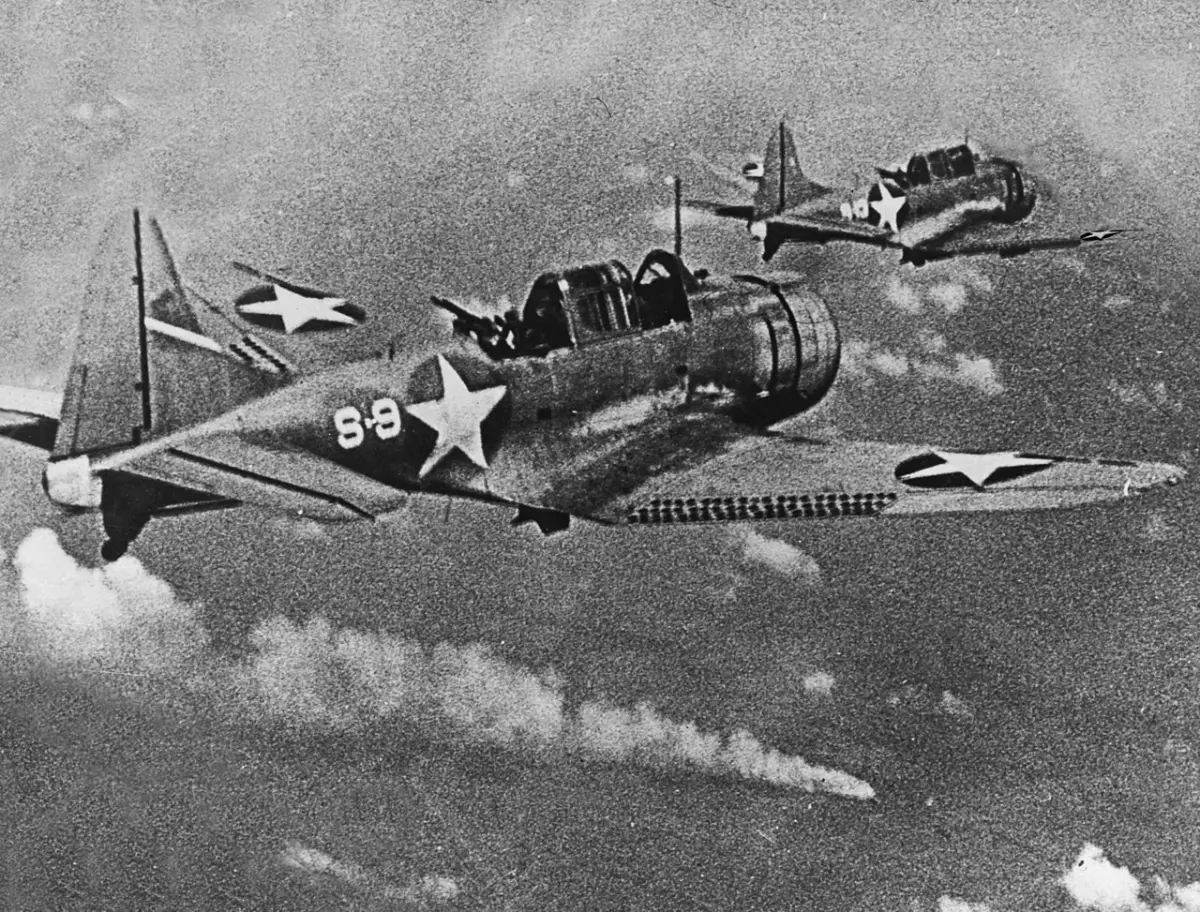
One scene from this battle has been told for decades: as the American dive bombers arrived, the Japanese decks were packed with a strike ready to go, five minutes from launching. A hair's breadth, and luck fell the other way — a satisfying shape for a story. It lets the losing side move the cause to chance, and it makes the winning side's victory dramatic.
It does not survive the Japanese primary records. Reconstructed from the ships' own flight records and from how deck operations actually worked, what stood on the decks around 10:20 was mainly the defensive fighter patrol, not a spotted strike. Launching a full deckload needed roughly 30–45 uninterrupted minutes across all four ships, and through a morning of successive attacks that window never opened once1.
The tale traces back to a participant's post-war memoir; Western accounts repeated it, and it stood as settled fact for half a century until researchers returned to the Japanese sources1.
The correction matters because the "five minutes" replaces cause with chance. "If only we had been five minutes earlier" pushes the intelligence, the search plan and the design of the procedure out of view. Once a defeat has been converted into bad luck, there is nothing left in it to learn. A story that blames luck consoles; it does not inform the next decision.
Counterfactuals — removing one factor at a time
These are thought experiments for weighing factors, not claims about what happened.
Without the codebreaking. The American carriers most likely stay near Hawaii and Japan takes the atoll. But holding it costs a long supply line, and the carriers remain in being. Japan would have gained a forward perimeter and a longer logistics problem. Without the intelligence the Americans do not "lose"; the reckoning is postponed.23
If the Tone's search aircraft had not been late. The Americans might have been found thirty to sixty minutes earlier. But what Nagumo needed was 30–45 continuous minutes, and the attacks kept coming in waves. There is no guarantee the window opens. Blaming the battle on one aircraft has the same shape as the five-minute story.1
If Yorktown had not been repaired. Two carriers instead of three thins the density of the dive-bomber attack, and three carriers burning within minutes becomes far less likely. The dockyard decision to return a damaged ship in days weighed as much as any tactical choice.2
What transfers — beyond the sea
Information is worth nothing until it moves resources
A correct forecast that changes no allocation produces the same result as a wrong one.
Settle ambiguity by experiment
"Where is AF?" was not argued out; a marked message was released and the answer came back. Most internal guessing matches can be ended by one small test.
Take the other side's preparation time
Competition is decided not only by output but by how much uninterrupted time your rival needs and does not get. Repeated pressure can beat one large blow.
Audit procedures against their time assumptions
The more a procedure is optimised for normal conditions, the more silently it assumes quiet time. Keep a degraded-mode version for when that assumption fails.
Never file a defeat under bad luck
"We were so close" ends the analysis. The feeling of near-miss is what stops an organisation from finding the cause.
In closing — can you turn knowing into time?
Japan lost four carriers and the accumulated skill embarked in them; the United States gained the footing to move from defence to offence in the Pacific. But the decisive difference that day was neither hulls nor training.
One side knew the enemy's plan and converted it into a coordinate on a chart and a time on a launch order. The other executed a procedure that required quiet time, without knowing what the enemy was doing. Information superiority is not a quantity of knowledge; it is the number of times you get to move first.
At Austerlitz the bait was a height the enemy believed he had to take, and the centre emptied. At Cannae a centre that looked ready to break drew the enemy's mass into a bag. At Midway what was taken was the time the enemy's own procedure required. Design the space or design the clock — either way, the move is to build the opponent's reasonable behaviour into your own structure.
Frequently asked questions
Sources
- Jonathan Parshall, Anthony Tully, Shattered Sword: The Untold Story of the Battle of Midway, Potomac Books (2005)
- Craig L. Symonds, The Battle of Midway (Pivotal Moments in American History), Oxford University Press (2011)
- Gordon W. Prange, Donald M. Goldstein, Katherine V. Dillon, Miracle at Midway, McGraw-Hill (1982)
- Samuel Eliot Morison, History of United States Naval Operations in World War II, Vol. IV: Coral Sea, Midway and Submarine Actions, Little, Brown (1949)
Related cases — read in comparison