Vicksburg — what fell was not a town but a line
On 4 July 1863, after a siege of forty-seven days, Vicksburg surrendered. What gets told is a long siege. But that it could not be taken frontally was known from the start. What changed was the object — not take the town, but open the river the town was corking. The moment it was put that way, every means connected.
- The object was never the town but the Mississippi it was corking. Put that way, the fleet's one-way passage and the deliberate cutting of the supply line become one design.
- Grant cut loose from his own supply. What he gave up was not supplies but the obligation to defend a line — and the trade bought five actions in seventeen days.
- Unusually for this site, the victory told outside its own arena. The reason is that what happened was not the outcome of a battle but a permanent rearrangement of logistics.
The protagonist is shown in blue, the opponent in red.
- Date
- March 29, 1863
- Place
- Vicksburg and its approaches, Mississippi, USA
- Key figures
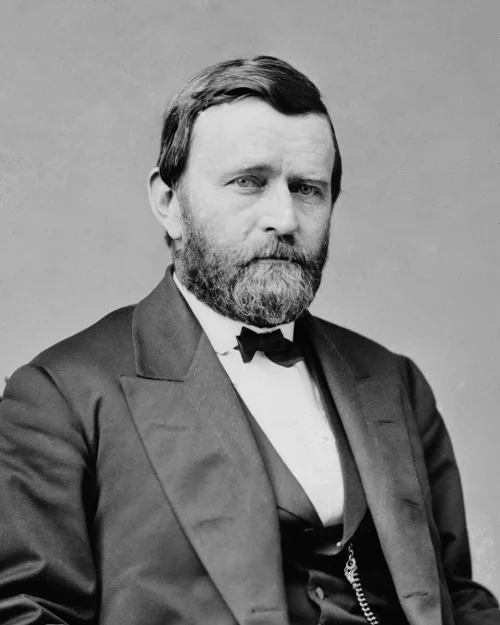
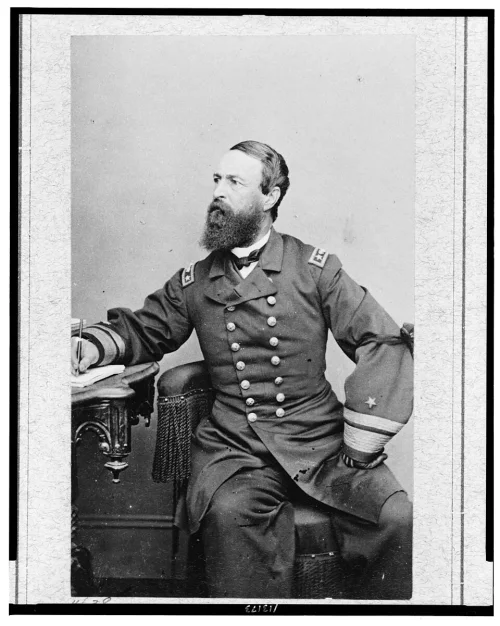
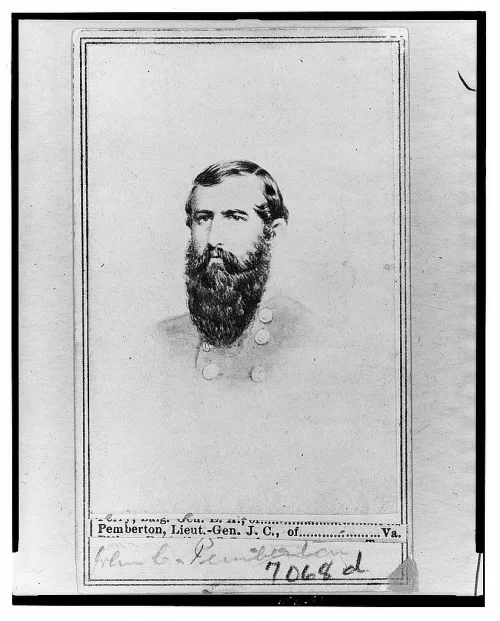
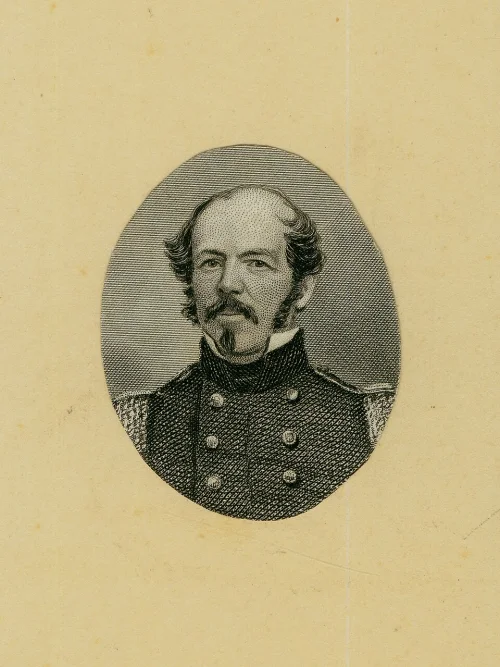
- 4
- Result
- Decisive Union victory (the Confederate garrison surrendered)
Contents
- Background — the town was not a town but a stopper
- The besiegers and the besieged
- The campaign in figures
- Deployment — three decisions to give something up
- Thesis — what fell was not a town but a line
- Two layers — the surface campaign and the design beneath
- The course — 1863
- Inside the ring — what a design of supply costs
- What actually decided it
- Why the losers were not fools
- Aftermath — this victory, unusually, told outside its own arena
- The story — that the turning point was Gettysburg
- Counterfactuals — remove one factor at a time
- What transfers — in other arenas
- In closing — a stopper can be pulled without being hit
Background — the town was not a town but a stopper
By 1863 the Civil War was in its third year. The Mississippi was the spine of the continent's freight and, at the same time, the line that held the Confederacy's two halves together. Cattle, grain and men came across from Texas, Arkansas and western Louisiana14.
The Union already held New Orleans at the mouth and Memphis upstream. Two stoppers remained: Vicksburg, and Port Hudson below it. Vicksburg did not matter as a town. It mattered because, while that one point was corked, the river could not be used as a line.
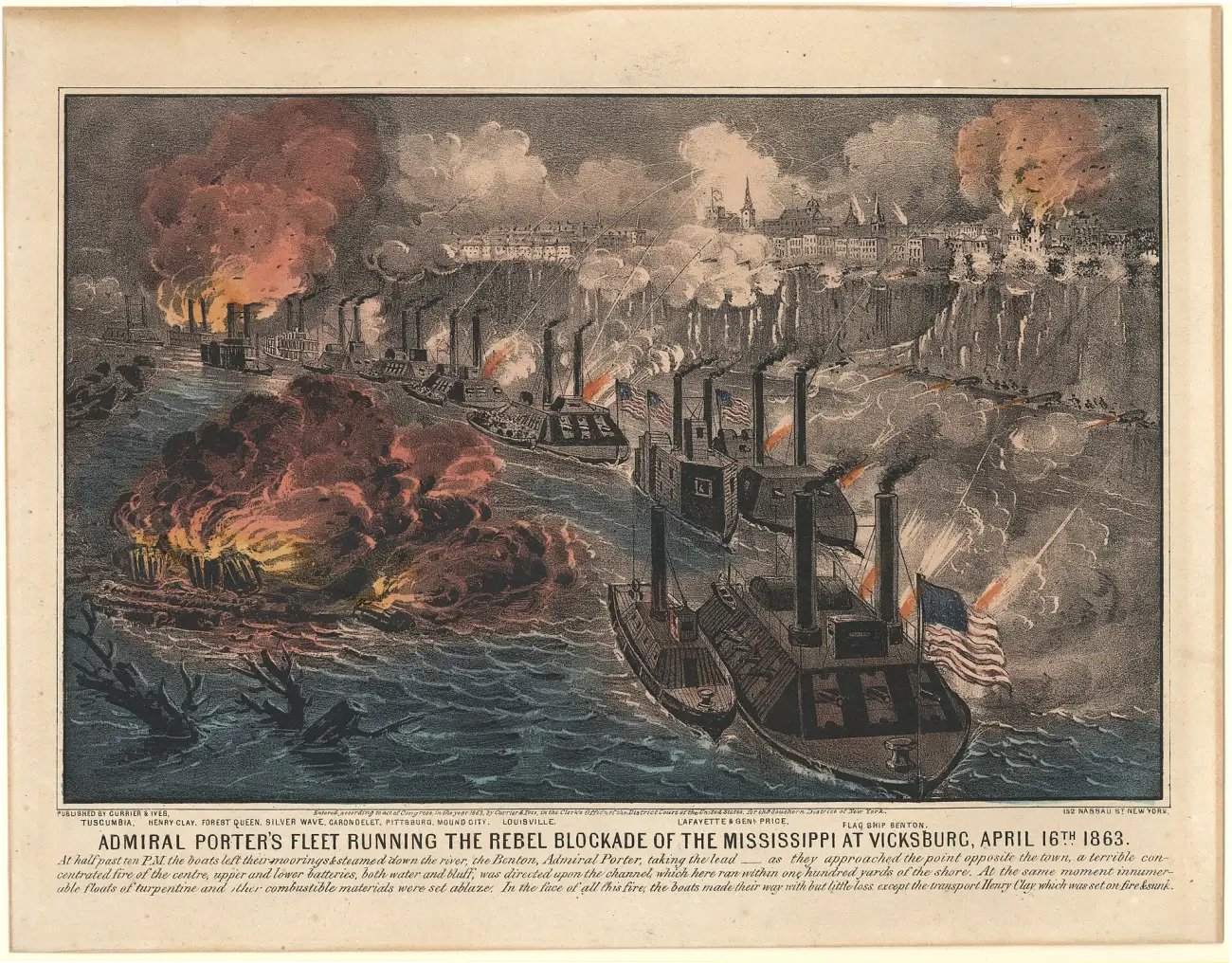
And the stopper could not be pulled frontally. The town sits on a bluff at a bend, its batteries firing down from some 60 metres above the water; the approaches from the north are swamp and bayou. Since the previous winter Grant had failed at nearly everything, including an attempt to dig a canal and move the river itself13.
Which sets the question. How does a fortress everyone agrees cannot be taken frontally fall without a frontal attack?
The besiegers and the besieged
But this ratio is a result, not a cause. During the inland manoeuvre Grant had around 35,000–45,000 men, and locally the numerical edge was not decisive. Numbers began to tell only once the enemy was shut inside the town13.
The campaign in figures
| Union (protagonist) | Confederates (opponent) | |
|---|---|---|
| Strength during the inland march | c. 35,000–45,000 | — |
| Strength late in the siege | c. 70,000–77,000 | c. 29,000–30,000 (garrison) |
| Actions in 17 days | 5, all won | 5, all lost |
| Distance marched | c. 290 | — |
| Killed and wounded in the campaign | c. 9,000–10,000 | c. 9,000–10,000 |
| Lost at the surrender | — | 29,000–30,000 men and 172 guns |
The figures move by source. The row that matters is the last one. In a single day the Confederacy lost an army and the artillery it would have needed to rebuild one.12
Deployment — three decisions to give something up
The campaign is built out of three acts of giving something up.
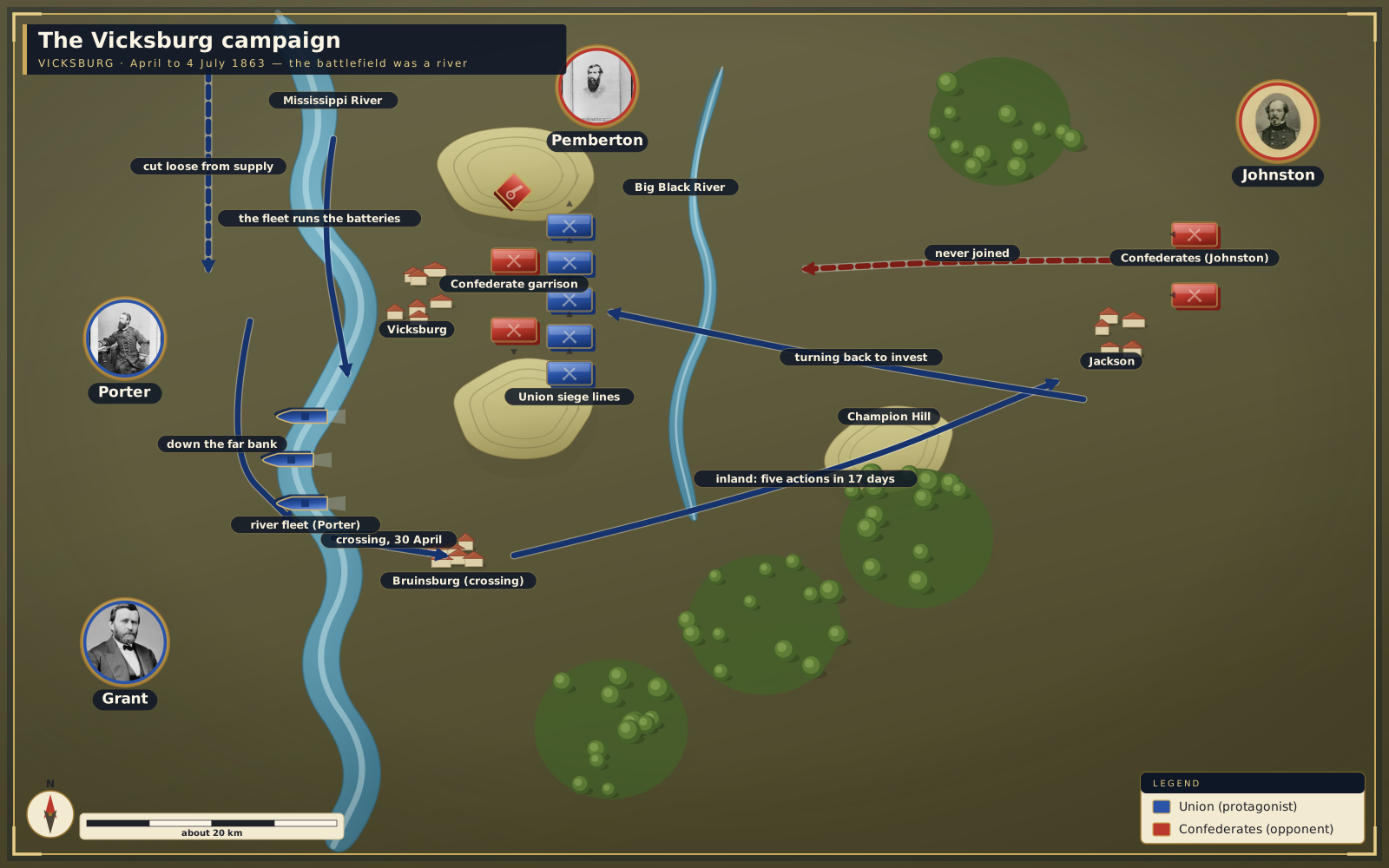
First, the fleet's line of retreat. On the night of 16 April, Porter's 12 or so vessels passed directly under the batteries and came out to the south. Ships that ran past could not fight the current back up. It was one-way, and failure would have cost the fleet. Success meant a means of crossing and supply below the town13.
Second, the supply line. Grant marched down the far bank, crossed to the east side at Bruinsburg on 30 April, and then cut loose from his line to the north. Supplies stop arriving, and the line that had to be guarded stops existing. The troops moved living largely off the country13.
Third, the objective itself. He did not head straight for the town. He went east to Jackson, drove off the force there and wrecked the railway and the stores, and only then turned back towards Pemberton. He gave up "reach the town quickly" in exchange for "keep the two enemy forces apart".
Thesis — what fell was not a town but a line
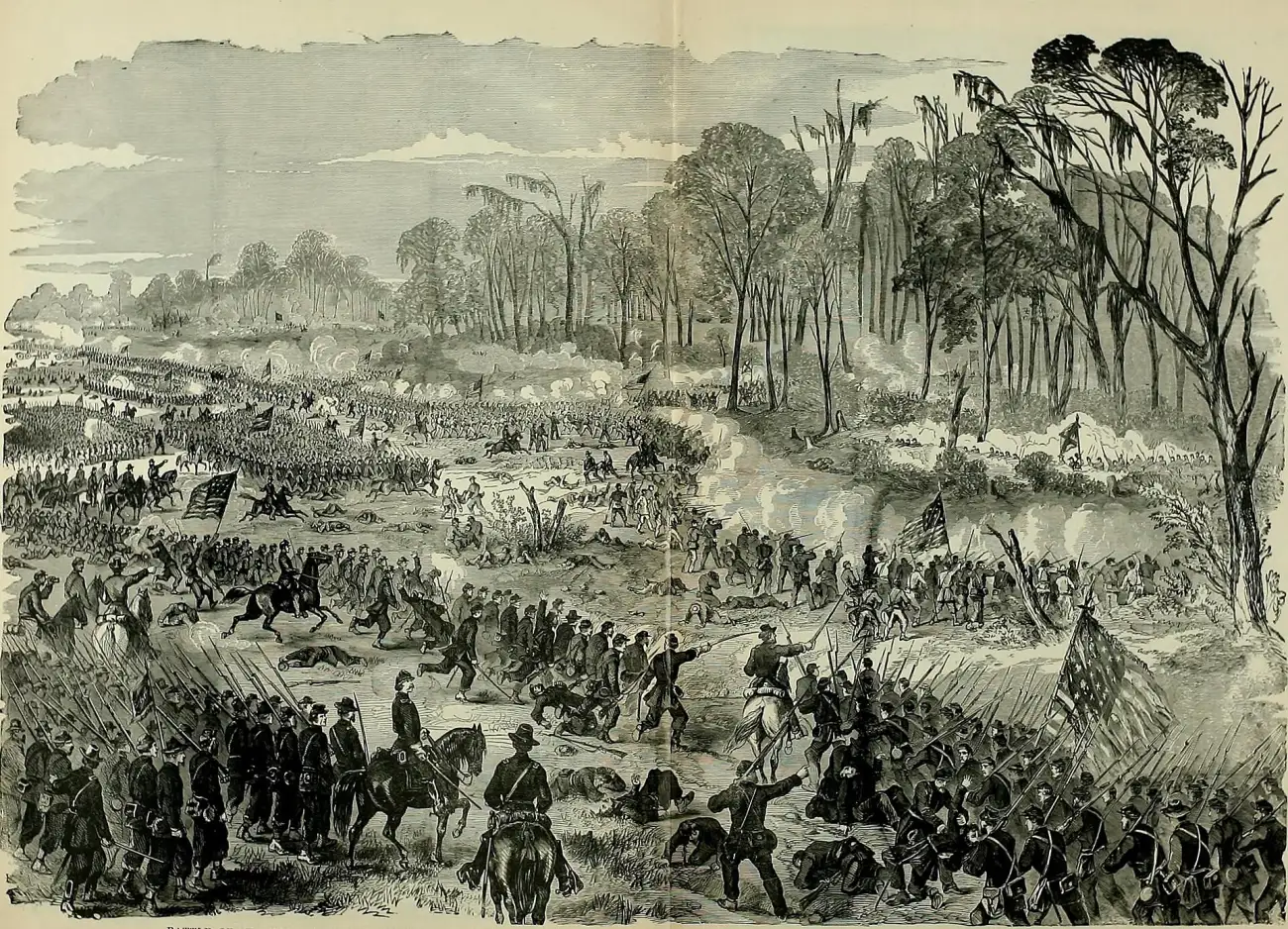
5 actions in 17 days: Port Gibson, Raymond, Jackson, Champion Hill, Big Black River. None of them is a battle on the way to the town; each is a battle to keep two Confederate forces from joining.13
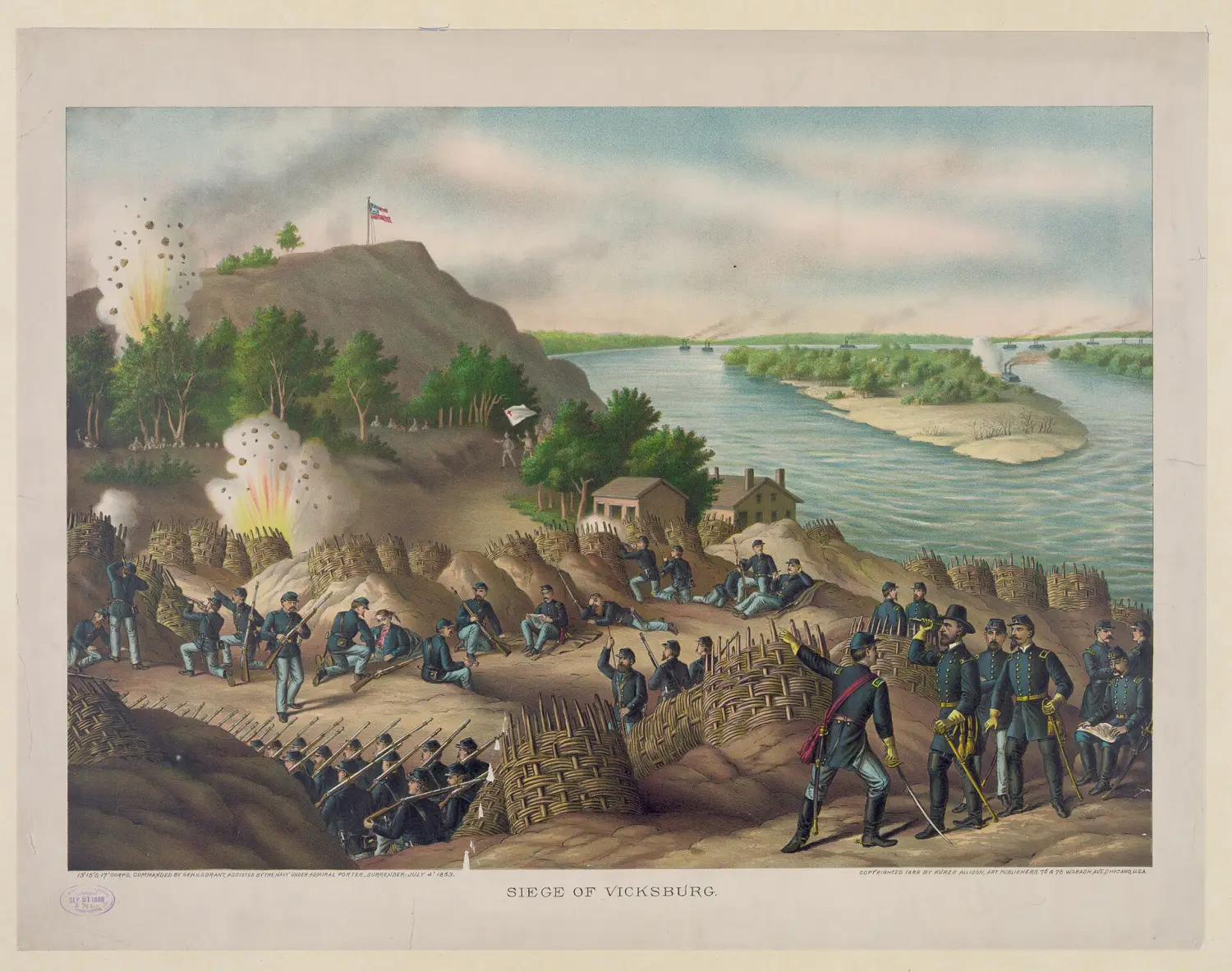
The result was that Pemberton was pushed into the town and Johnston was left outside it. The assaults of 19 and 22 May both failed. So Grant stopped assaulting and started digging. Trenches crept forward, mines went under the works, guns were emplaced, the fleet fired from the river. 47 days later the garrison ran out of food and surrendered2.
This is the core of the structure. The object of the campaign was never the town. It was the river the town was corking. The town was the stopper, and a stopper can be dealt with by hitting it or by working round it. What worked was the second.
So the pattern this case carries is a design of supply. The decision comes not from what the enemy holds now but from whether things keep reaching him. Which means the work before fighting is to make his line the battlefield, and, if necessary, give up your own for a while.
The object was not the town but the line the town was corking. So the stopper could be pulled without being hit.
Thesis
Two layers — the surface campaign and the design beneath
The fleet ran past the batteries at night.
The Union army cut loose and went inland.
The Union struck Jackson to the east first.
Both May assaults failed.
The hinge is whether you can then stop assaulting and switch to digging. Do not require the victory to look impressive2.
The course — 1863
Attempts through the swamps from the north, and to dig a canal and move the river, all fail13.
Porter's 12 or so vessels run directly under the batteries and come out to the south. One-way, and the hinge of the whole campaign.13
The army crosses to the east bank at Bruinsburg and cuts loose from its supply line to the north13.
5 actions in 17 days — Port Gibson, Raymond, Jackson, Champion Hill, Big Black River — over some 290 km of marching13.
Jackson is taken and its railway and stores wrecked. From here on, Johnston and Pemberton never join.1
Two general assaults. Both fail and leave nothing but casualties2.
Digging. Trenches creep forward, mines go under the works, the fleet fires from the river. Civilians shelter in caves cut into the hillsides2.
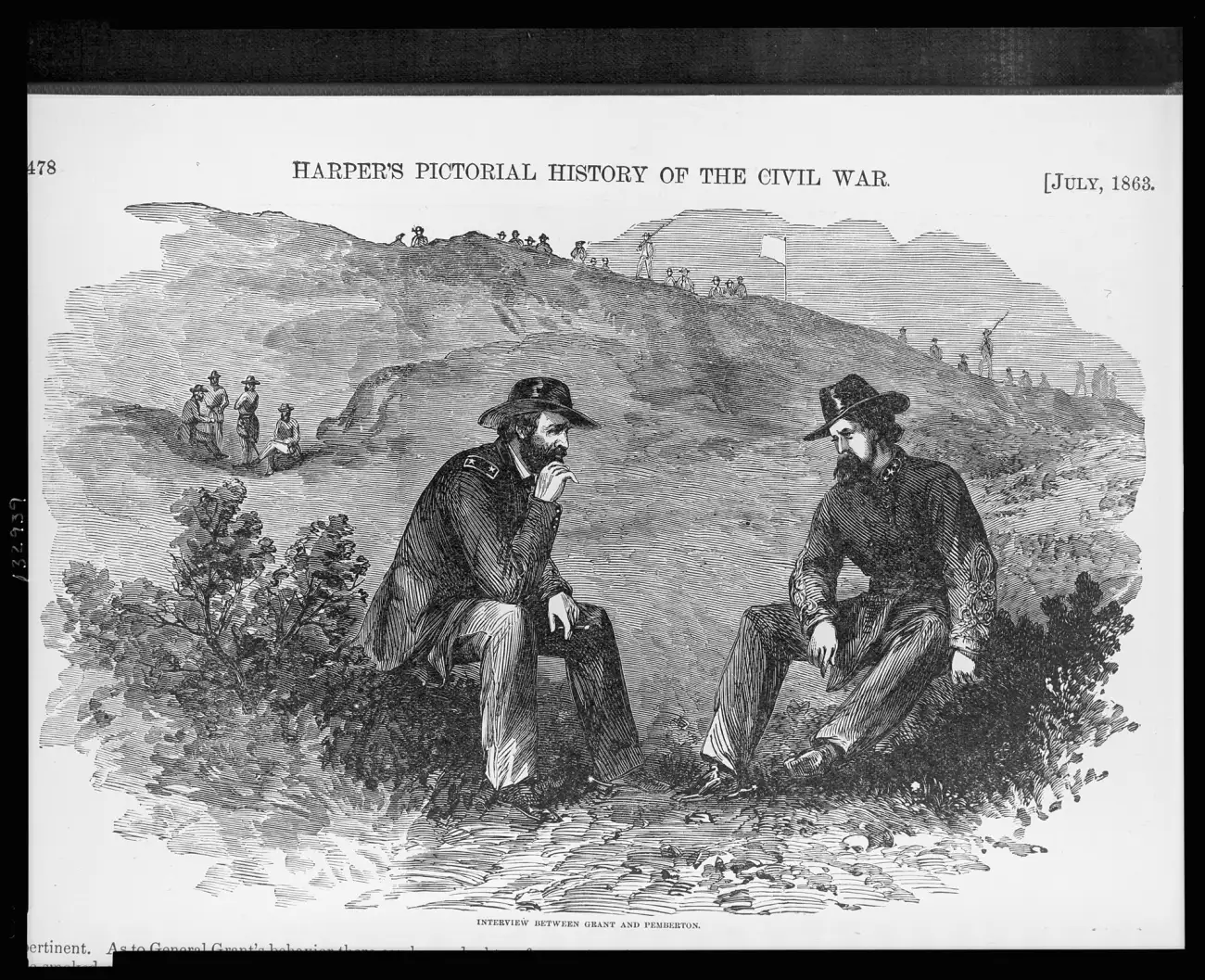
Grant and Pemberton discuss terms. Grant decides to parole the prisoners rather than ship them north2.
Port Hudson downstream surrenders too. The whole Mississippi passes into Union hands and the Confederacy is cut in two.4
Inside the ring — what a design of supply costs
The garrison was not alone in the town. Some 3,000–5,000 civilians stayed. To get out of the shelling they cut into the hillsides and lived in an estimated 500 caves through the heat and the bombardment. By June the food had gone: mule meat appeared in the market, and rations of peas and ground corn were issued as a substitute for bread2.
This is not a sad aside; it is part of the pattern. A design of supply cannot starve only the enemy's army. Stop the line and everybody inside the line pays the same price. The reason a siege is the dull, reliable method is that the reliability is being charged to somebody.
The same thing was written at Stalingrad. A design decides whether it can be won, not whether it will be paid for lightly. Reading something as structure means putting the effect and the price on the same page.
What actually decided it
Replace the town with the line as the object
Taking a town and opening a river are different aims. Set the second as the object and the range of available means widens14.
Break the premise once
"No fleet can pass" does not mean no fleet can pass on any given night. Line up darkness and speed and once is possible — one-way13.
Delete the line you guard and buy speed
Cut loose and you go hungry, and you also stop detaching troops to guard. 5 actions in 17 days is the result of that trade13.
Keep the two of them apart
Striking Jackson first outranked reaching the town quickly. Let them join and the besieger is the one caught between12.
Stop assaulting
After two failures in May he switched to digging. Not requiring the victory to look impressive is, here, a technique2.
Why the losers were not fools
Reading Pemberton as an incompetent who shut himself in a town and lost an army is not accurate. He was being given different orders by two superiors.
Johnston, commanding the department, said it repeatedly: abandon the town, save the army, join me. President Davis said: hold Vicksburg. Both were superiors and both had a case. Johnston was militarily right and Davis was politically right, because the town was also the proof that the Confederacy was holding14.
And Pemberton was Pennsylvania-born, a Confederate general whose origins were held against him. A man already under suspicion finds it hard to choose the option that would seem to confirm it. So he took a little of each, stayed half-committed to both the town and the army, and lost both. Splitting the difference is not a decision.
Kutuzov at Austerlitz, Paullus at Cannae, Gravina at Trafalgar, Paulus at Stalingrad, Boucicaut at Agincourt, Gérard at Waterloo — and now Pemberton. A correct reading losing to a structure makes its seventh appearance on this site, this time in the variant "two superiors who say different things" — the same failure as two consuls commanding on alternate days at Cannae, reappearing in 1863.
The other man deserves a look too. Johnston never let go of the order of priority: a town can be given up, an army cannot. Judging that the force he had could not break the siege, he did not attempt a relief he could not deliver12. Militarily that is right.
So this case has two people whose correct reading did not carry. Pemberton could not decide; Johnston decided and was not heeded. The first is the consequence of a forked chain of command, the second of a sound military judgment colliding with a political necessity. There is more than one way for a structure to break.
Aftermath — this victory, unusually, told outside its own arena
Vicksburg surrendered on 4 July and Port Hudson downstream on 9 July, and the whole Mississippi passed into Union hands. The Confederacy was cut in two, and the cattle, grain and men that had come from the western bank stopped coming14.
At Cannae, Trafalgar, Stalingrad and Agincourt this site has repeatedly watched the rule that a decisive victory is decisive only inside its own arena, and at Waterloo its inverse. Vicksburg is one of the few exceptions.
Why it is an exception is itself structural. What happened here was not the outcome of a battle but a permanent rearrangement of logistics. The outcome of a battle can be recovered in the next battle. Control of a river has to be taken back by another campaign, and the Confederacy did not have one to spare. If a victory tells outside its arena, it is not because it was won but because it rewrote the conditions.
The story — that the turning point was Gettysburg
The turning point of the Civil War was Gettysburg: that is the most widely circulated account. Line the dates up and it gets strange. Gettysburg ended on 3 July and Vicksburg surrendered on 4 July. They are the same week.
And they told differently. Gettysburg stopped Lee's invasion of the north, but Lee's army survived and the war ran on for nearly two more years. Vicksburg halved the Confederacy's logistics permanently and deleted an army and 172 guns. It is still Gettysburg that is remembered4.
The reason is structural, and that is the interesting part. Gettysburg was a dramatic battle that took three days, happened on the eastern front where the capital and the newspapers were, had Lee in it, and could be summed up in one scene: that charge. Vicksburg took three months, happened in the west, was decided by digging, and has no scene to sum it up.
What separates the famous battle from the one that told is often how easily it makes a drama. This is the same mechanism as the frozen ponds at Austerlitz, the fateful five minutes at Midway and "a near-run thing" at Waterloo — but running the other way. Those are stories in which the contents of an event were inflated; this is one in which an entire event dropped out of view.
The images confirm it. The Kurz & Allison lithograph above shows a general assault; what actually took the town was digging. A picture cannot show digging. What cannot be pictured tends to fall out of the memory unpictured.
Counterfactuals — remove one factor at a time
A: if the fleet had not got past on 16 April. No means of crossing or supplying below the town, and the move to the east bank does not happen at all. The hinge of this campaign is not a battle but one irreversible night passage.
B: if Jackson had not been struck first. Johnston and Pemberton join, and the army trying to besiege is caught between them. "Hurry to the town" was, in this case, wrong.
C: if the supply line had been kept. Troops are detached to guard it and the pace drops; 5 actions in 17 days is not available. What was given up was not supplies but the obligation to defend.
Each is an untestable thought experiment, not a claim about what was. Only by removing a factor does its weight become visible.
What transfers — in other arenas
Look at what reaches him, not what he holds
Not the competitor's revenue but their suppliers, distribution and hiring pipeline. That is usually where it is decided. Why this example: the object was the river, not the town.
Drop a fixed cost for a fixed period and buy speed
Letting go of something you were protecting widens the range you can move in — chosen knowingly, and without a way back.
Keep his two halves from joining
Settle it while the other side's two departments, or two decision-makers, are still out of step. Let them join and you are the one caught between.
Ask whether the "impossible" can be broken once
What cannot be done routinely can sometimes be done once if the conditions are lined up — counting the fact that it is one-way.
Count the famous events and the effective ones separately
Only the summarisable events stay in the memory. When reviewing, be suspicious of whatever made a good story.
In closing — a stopper can be pulled without being hit
Summarise Vicksburg as a long siege and you miss the core. That it could not be taken frontally was known from the start. What changed was the object. Not take the town but open the river the town was corking. The moment it was put that way, the one-way passage of the fleet, the cutting loose from supply and the strike to the east all connected into a single design.
And the decision came not from an assault but from 47 days of unglamorous work. Not requiring the victory to look impressive is, here, a technique. The price of that was losing the memory to a more dramatic victory won the same week.
What this case adds to the seven already here is an eighth type. Austerlitz was a design of space, Cannae of momentum, Midway of time, Trafalgar of command, Stalingrad of attachment, Agincourt of frontage, Waterloo of convergence. Vicksburg is a design of supply — make his line the battlefield, and give up your own for a while if you must.
One last thing. This site has repeatedly found that a decisive victory is decisive only inside its own arena. Vicksburg is an exception, and the reason it is an exception explains the rule. What happened was not the outcome of a battle but a rewriting of how things move. If a victory tells outside its arena, it is not a victory that was won but one that changed the conditions.
Frequently asked questions
Sources
- Michael B. Ballard, Vicksburg: The Campaign that Opened the Mississippi, University of North Carolina Press (2004)
- Timothy B. Smith, The Siege of Vicksburg: Climax of the Campaign to Open the Mississippi River, University Press of Kansas (2021)
- Edwin C. Bearss, The Vicksburg Campaign (3 vols), Morningside House (1985–1986)
- James M. McPherson, Battle Cry of Freedom: The Civil War Era, Oxford University Press (1988)
Related cases — read in comparison