Person
Erwin Rommel
Commander, Army Group B (the Atlantic Wall)
Life: 1891–1944
The commander who estimated the decisive window correctly and could not get his deployment adopted.
He judged that Allied air superiority would make it impossible to bring reserves up from inland, and therefore that a landing could only be stopped at the water's edge within the first twenty-four hours — so the panzer divisions should sit immediately behind the beaches. Post-war assessment has largely agreed with the reading; the deployment was not adopted. On 6 June, with the tide and weather tables ruling a landing out, he was in Germany.
Strategic signature — assume it is decided on the first day
Rommel read the problem differently from the other commanders in the west. Under Allied air superiority, moving reserves up from inland would not be possible at all. Therefore a landing had to be stopped at the water's edge, inside the first twenty-four hours — so put the panzer divisions immediately behind the beaches4.
Post-war assessment has largely judged that reading correct. He could not get the deployment adopted. Rundstedt argued for concentration inland, and part of the armoured reserve was held at Hitler's own disposal. Three positions stood side by side and none of them was executed.
And on 6 June he was not in Normandy. The tide and weather tables ruled out a landing in that window, so he had gone home to Germany for his wife's birthday. On a battlefield where the enemy had manufactured the information, even the forecast was on their side.
Recurring patterns
Fix the window in which it is decided
Reading the clock as "everything is settled in the first twenty-four hours" produces an entirely different allocation of resources.
Treat air control as a precondition, not a factor
The side without the sky pays to move at all. He counted mobility as part of combat power.
Be right and not be adopted
His deployment was rejected. The quality of a reading and the authority to act on it are separate things.
Strengths and weaknesses
Estimates the decisive time window correctly.
Without the authority to move resources to that window, a correct estimate leaves no trace at all.
Inspects the front in person.
Judgement then leans on what he has seen. What he cannot see — the intelligence picture in Britain — is entirely out of reach.
Connection to Normandy
This case has two men who read it correctly and did not prevail. Rommel could not get his deployment adopted; Rundstedt's sound doctrine was fed a manufactured input. The shape of Mitsunari and Ōtani at Sekigahara appears again, for different reasons.
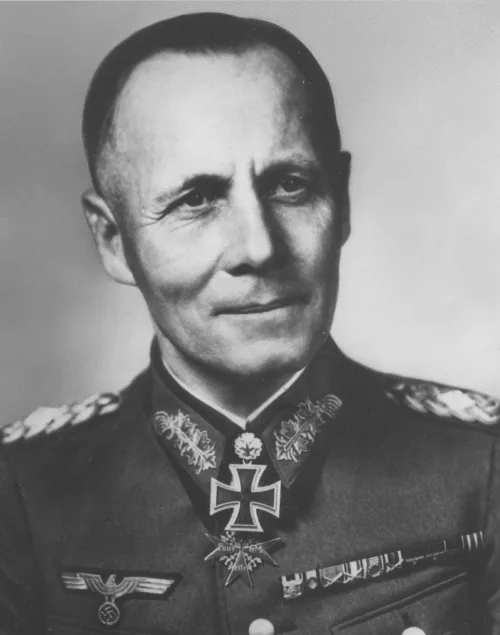
Erwin Rommel, 1941. Public Domain, via Wikimedia Commons
Appears in