Person
Wilhelm, German Crown Prince
Commander, German Fifth Army
Life: 1882–1951
The executor who said "stop" early from the field, and could not stop it.
The German Crown Prince, who ran the Verdun front in practice. What matters about him is not success but that he pressed early for the offensive to be broken off. The reason it did not stop is structural rather than personal: a plan without a stopping condition contains no number that can support the sentence "we should stop now". After the war the responsibility attached to his name — the usual fate of the executor of a failed design.
Strategic signature — see it first from the field, and be unable to stop it
Wilhelm, the German Crown Prince, commanded Fifth Army and ran the Verdun front in practice. What matters about him is not success but that he saw it early. During the first half of 1916 his headquarters was already pressing for the offensive to be broken off13.
It did not stop. The reason is less personal weakness than structure. A design for consumption with no stopping condition contains no number that can support the sentence "we should stop now". The ratio moves a little each day. No line has been drawn anywhere that could be used as grounds for stopping.
He was also the Crown Prince. After the war the responsibility for Verdun attached easily to his name. The phrase "the butcher prince" comes from enemy propaganda of the time. The executor is often made to carry the failure of the design as well.
Recurring patterns
The field sees it first
A worsening ratio is visible at the front headquarters before it is visible in the statistics. Seeing it and being able to stop it are separate abilities.
No grounds for stopping
In a plan without a stopping condition, the burden of proof falls on whoever wants to stop. That is not a matter of logic; it is a matter of what the document contains.
The name that survives is the executor's
The failure of a design tends to enter history under the proper noun of the person who carried it out.
Strengths and weaknesses
Can report a flaw in the design early, from where it is being executed.
When the report goes to the designer himself, it is processed as loss of nerve.
Rank provides a channel for the objection.
The same rank makes him the obvious place to hang the label afterwards.
Connection to Verdun
In a battle that consumed 714,231 people, somebody said "stop" early, and it did not stop. That is the genuinely frightening part of this case.
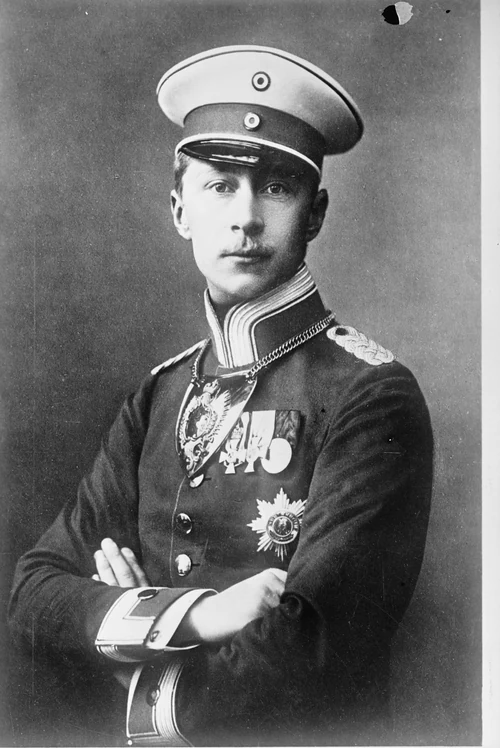
Wilhelm, German Crown Prince, about 1906, Harris & Ewing, Library of Congress. This is him a decade before Verdun. Public Domain, via Wikimedia Commons
Appears in