Verdun: what was contested was not ground but the exchange rate
At Verdun in 1916, Germany was after the exchange rate, not ground — or so Falkenhayn, who planned the offensive, wrote after the war. Whether that was the plan from the start is disputed among historians. What this case examines is the structure of attrition that resulted: guns massed on a place France could not abandon, processing whatever came. 302 days later the two sides had about 714,231 killed, wounded and missing, and the net distance moved was almost nothing. And the ratio was about one to nine tenths. What is worth reading here is not the horror. It is the structure: a design that never wrote down how to stop turned its own designer into part of the machine.
- As Falkenhayn told it, the contest was over the exchange rate, not ground (whether that was the original intent is disputed) — but the result was 377,231 French against about 337,000 German, roughly one to nine tenths. The stated purpose of the design was not achieved.
- The difference from a design of fixation (Stalingrad) is whether there is an elsewhere. Attrition has none: stepping out makes everything already spent a total loss, so you build a structure you cannot step out of.
- Falkenhayn, who designed it, was dismissed on 29 August 1916 and the battle ran another 111 days. With no stopping condition in the plan, stopping is the decision that needs grounds.
Pattern: a design of attrition →
The protagonist is shown in blue, the opponent in red.
- Date
- February 21, 1916
- Place
- Verdun and its surroundings, Meuse, north-eastern France
- Key figures
- 4
- Result
- The German offensive failed of its purpose; France retook most of the lost ground
Contents
- Background: a side with no way to win moved the definition of winning
- The claim: what was contested was not ground but the exchange rate
- The exchange rate: assumed and delivered
- Verdun in numbers
- Dispositions: where the machine was sited
- The defender's design: a noria and one road
- Two layers: what happened, and what was designed
- How it went: 1916
- How this differs from a design of fixation
- What actually did the work
- Consequences: what did not die at Verdun died in 1917
- The story: the Christmas Memorandum has never been found
- What carries over: on other ground
- In closing: the thirteenth pattern
Background: a side with no way to win moved the definition of winning
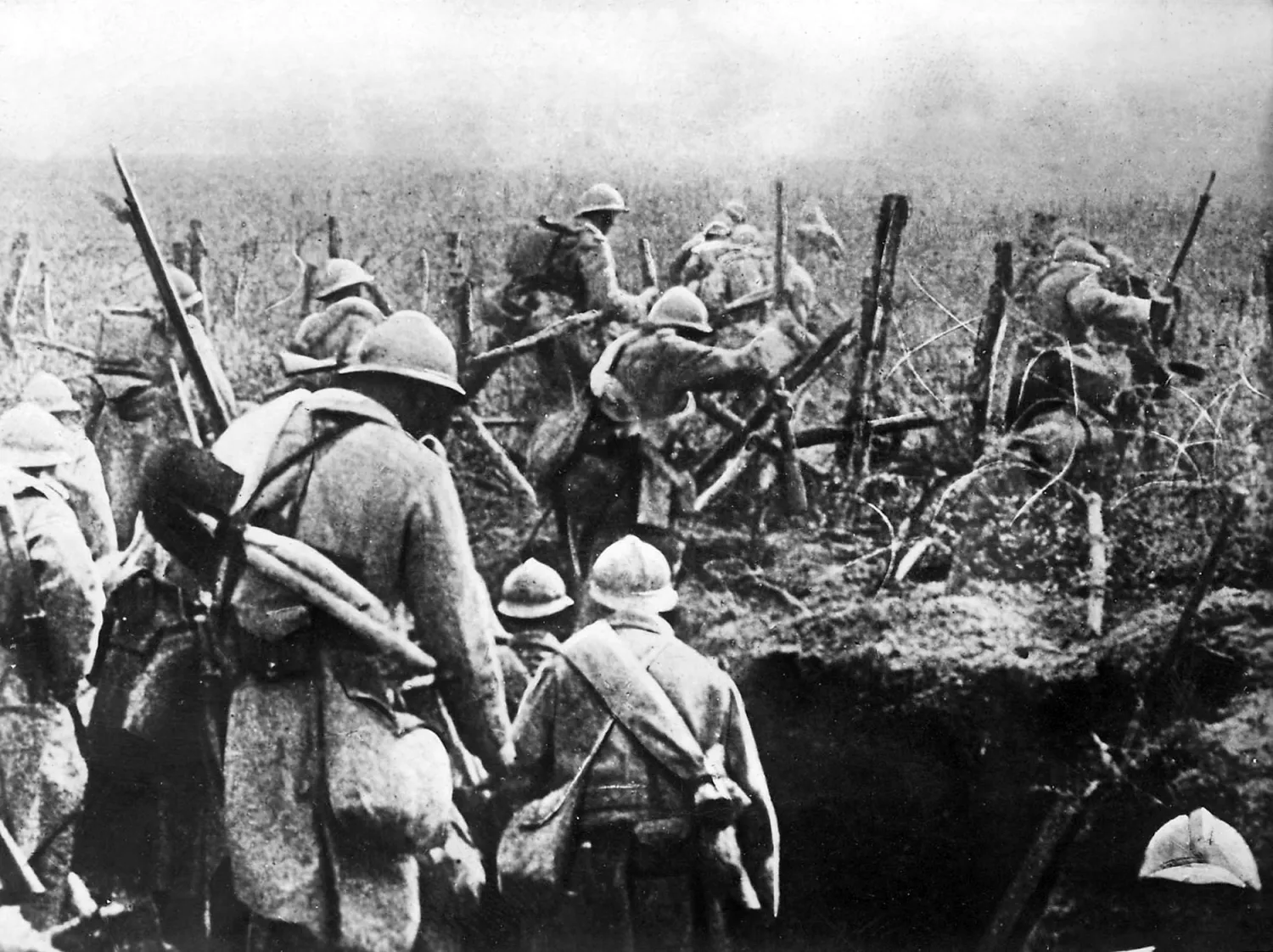
By the beginning of 1916 the Western Front had been immobile for more than a year. The trenches ran unbroken from the North Sea to the Swiss border, so there were no flanks. You could not go around, only through — and every attempt to go through killed more attackers than defenders.
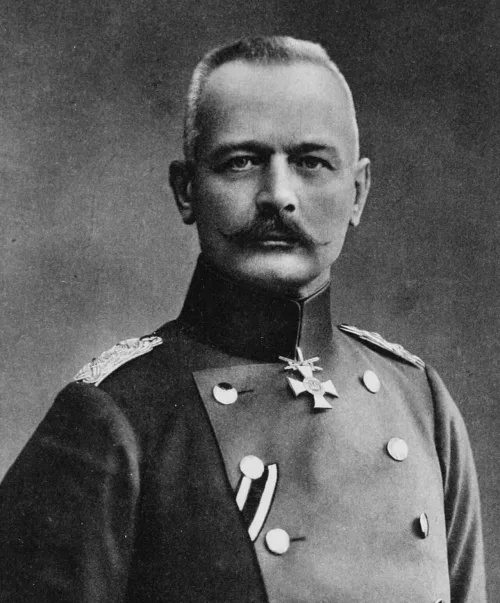
What faced Erich von Falkenhayn, the German Chief of the General Staff, was not a tactical problem but an arithmetic one. If you cannot break through, the only move left is to put winning somewhere else.
Where he put it was the exchange rate. Not taking ground but consuming the other side — and not indiscriminately. Choose a place the enemy cannot give up, and site the machine there. If they cannot abandon it they will keep sending men, and the guns will deal with whatever arrives.
The place chosen was Verdun: a fortress town on the Meuse that had been treated since the nineteenth century as somewhere France does not lose. The reason for choosing it was symbolic value, not military value. It did not have to be taken. It only had to look takeable.
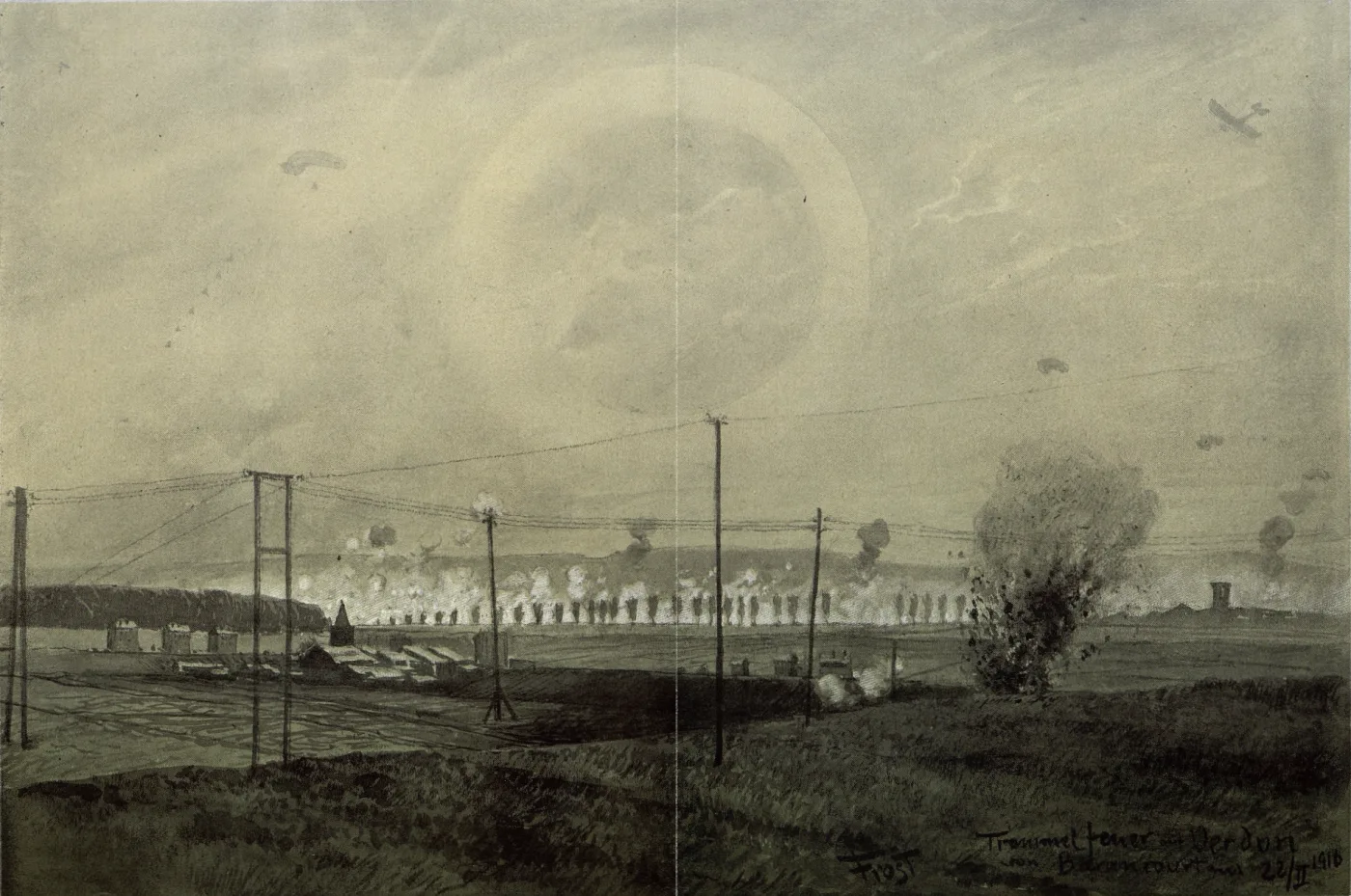
On 21 February 1916, 808 guns put roughly 1,000,000 shells in 10 hours into a box some 30 kilometres wide and 5 deep14. It was the heaviest bombardment of the war to that date. And 302 days later the front line was back at roughly its starting position.
The claim: what was contested was not ground but the exchange rate
Read Verdun as a tragedy in which two armies bludgeoned each other out of stubbornness and the structure disappears. There is a design here. And the design ate its designer.
What was contested was not ground. It was the exchange rate. Falkenhayn assumed France would lose heavily and Germany lightly: the law of the Western Front, that the attacker dies more than the defender, reversed by concentrating artillery. The infantry did not go forward to take ground; they went forward as bait to draw the French counter-attack, and the guns dealt with what came out.
The result was 377,231 French against about 337,000 German14. A ratio of roughly one to nine tenths. They consumed, and were consumed almost equally. The stated purpose of the design was not achieved.
Here is the thirteenth pattern. A design of attrition — a design whose object is the consuming itself. And it comes with a defect none of the other twelve cases carries.
There is no stopping condition. How many is enough? What do you do if the ratio comes out worse than assumed? Those lines are not in the plan for Verdun. So the side that built the machine went into it too.
What was contested was not ground but the exchange rate. And because no exit was provided, the side that designed the machine went into it too.
The claim
The exchange rate: assumed and delivered
That these two bars are nearly the same length is the whole case. The side that built the machine and the side fed into it came out with almost identical losses. The figures vary between studies; the representative values used here follow the post-war French official count and the German returns14.
Verdun in numbers
| Scale | What it means | |
|---|---|---|
| Duration | 302 days (21 Feb – 18 Dec 1916) | The longest single battle of the Western Front |
| Casualties | about 714,231 in total | 377,231 French, about 337,000 German |
| Opening guns | 808 guns, 10 hours, about 1,000,000 shells | Concentrated on a box 30 km wide and 5 km deep |
| Fort Douaumont | Fell on day 5 to about 100 men | It took 8 months to get it back |
| The Voie Sacrée | 75 km, a vehicle every 14 seconds | About 90,000 men and 50,000 tonnes a week |
| The noria | 70 of 95 divisions | Nearly the whole French army passed through here |
| The designer leaves | 29 August 1916 | The battle then ran another 111 days |
| Net distance moved | close to zero | France retook most of the lost ground (some only in August 1917) |
The last row determines the meaning of every row above it. 302 days and about 714,231 people bought almost no movement on the map145.
Dispositions: where the machine was sited
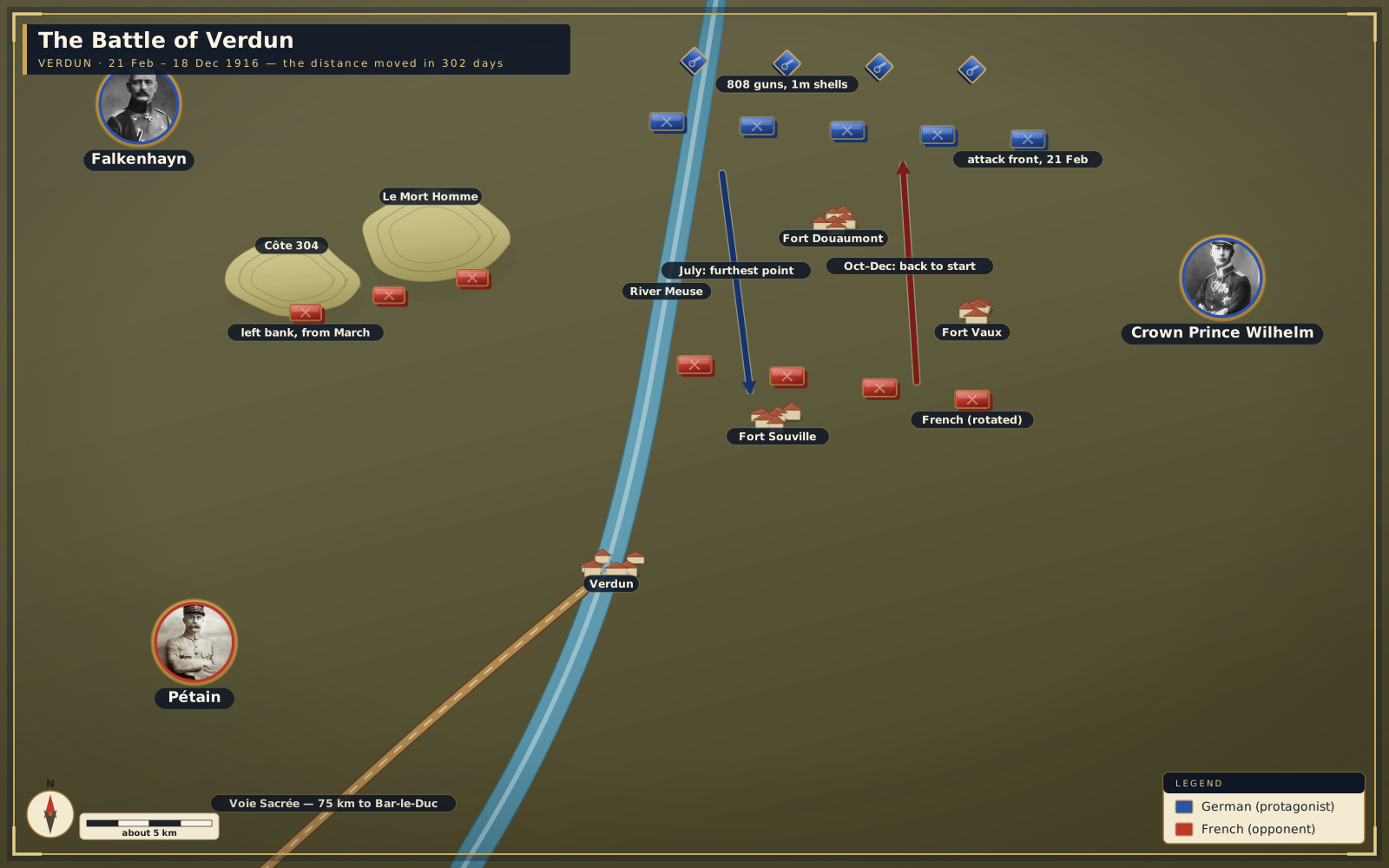
Verdun was a fortified zone. The Meuse runs north through it and forts stood on the hills of both banks: Douaumont, Vaux, Souville. During 1915, however, much of their heavy artillery had been stripped out and sent to other fronts. The place France would not lose was, by this point, substantially empty.
The German attack was directed only at the right bank. Leaving out the left bank was what allowed the guns to be concentrated. It was also the first thing to go wrong. French artillery left on the left bank fired into the flank of German infantry advancing on the right, and from March the Germans had to reach across for the left bank too — Côte 304 and Le Mort Homme. The frontage of the machine widened, and it widened to suit its owner, not its target.
On 25 February, on day 5, Fort Douaumont fell. There was almost no fighting for it. The garrison was thin, a small party of German soldiers found their way inside, and that was that — about 100 men, by the usual account14.
That single incident decided everything afterwards. Douaumont became the name of a thing France could not be without. Getting it back took 8 months, and tens of thousands of men were sent at it in the meantime. This was exactly the state Falkenhayn wanted — and the identical state grew on the German side as well.
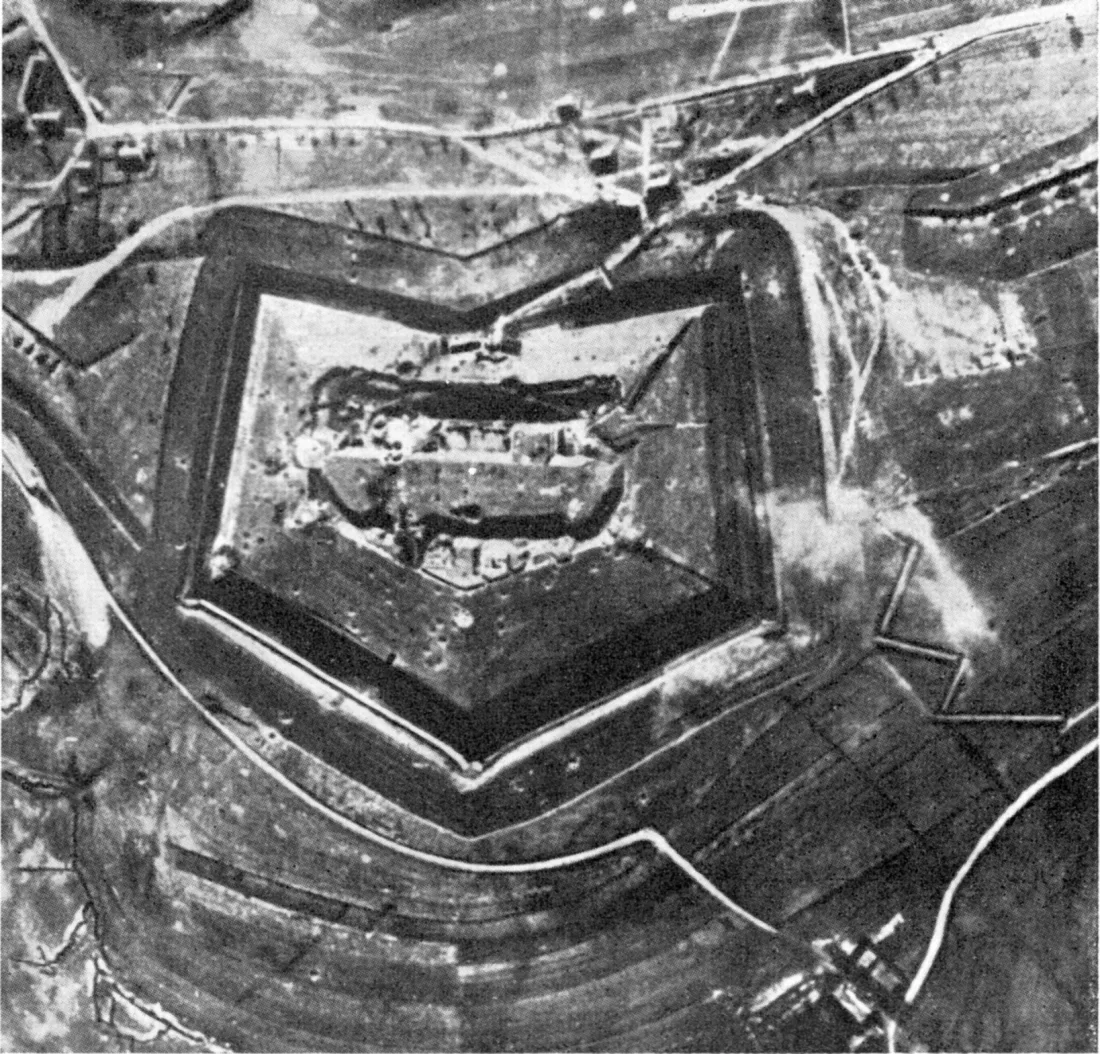
Fort Douaumont early in 1916, photographed by the German government photographic service. The corners of the work, the ditch and the edge of the earth cover can each be read. Public Domain, via Wikimedia Commons
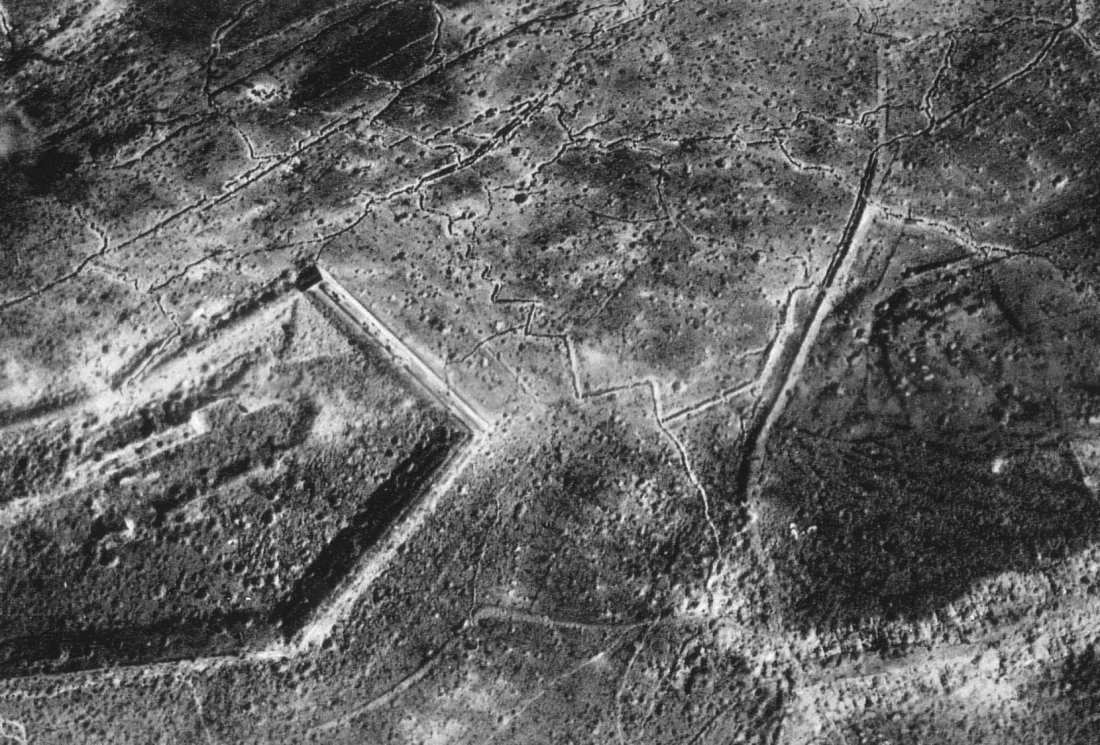
Fort Douaumont at the end of 1916, by the same German photographic service. It is the same fort. Public Domain, via Wikimedia Commons
The defender's design: a noria and one road
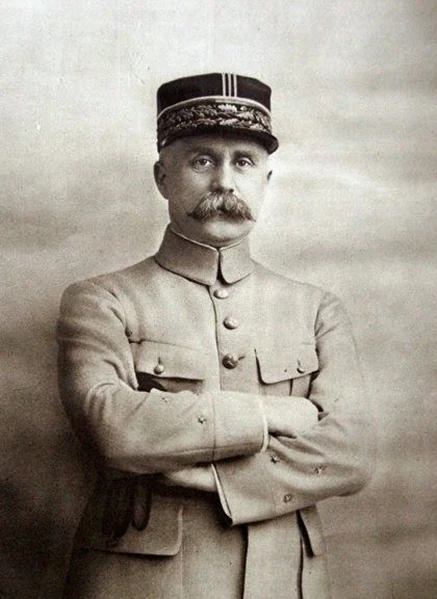
On 25 February, the day Douaumont fell, Pétain was given the Verdun front. What he did was logistics, not tactics.
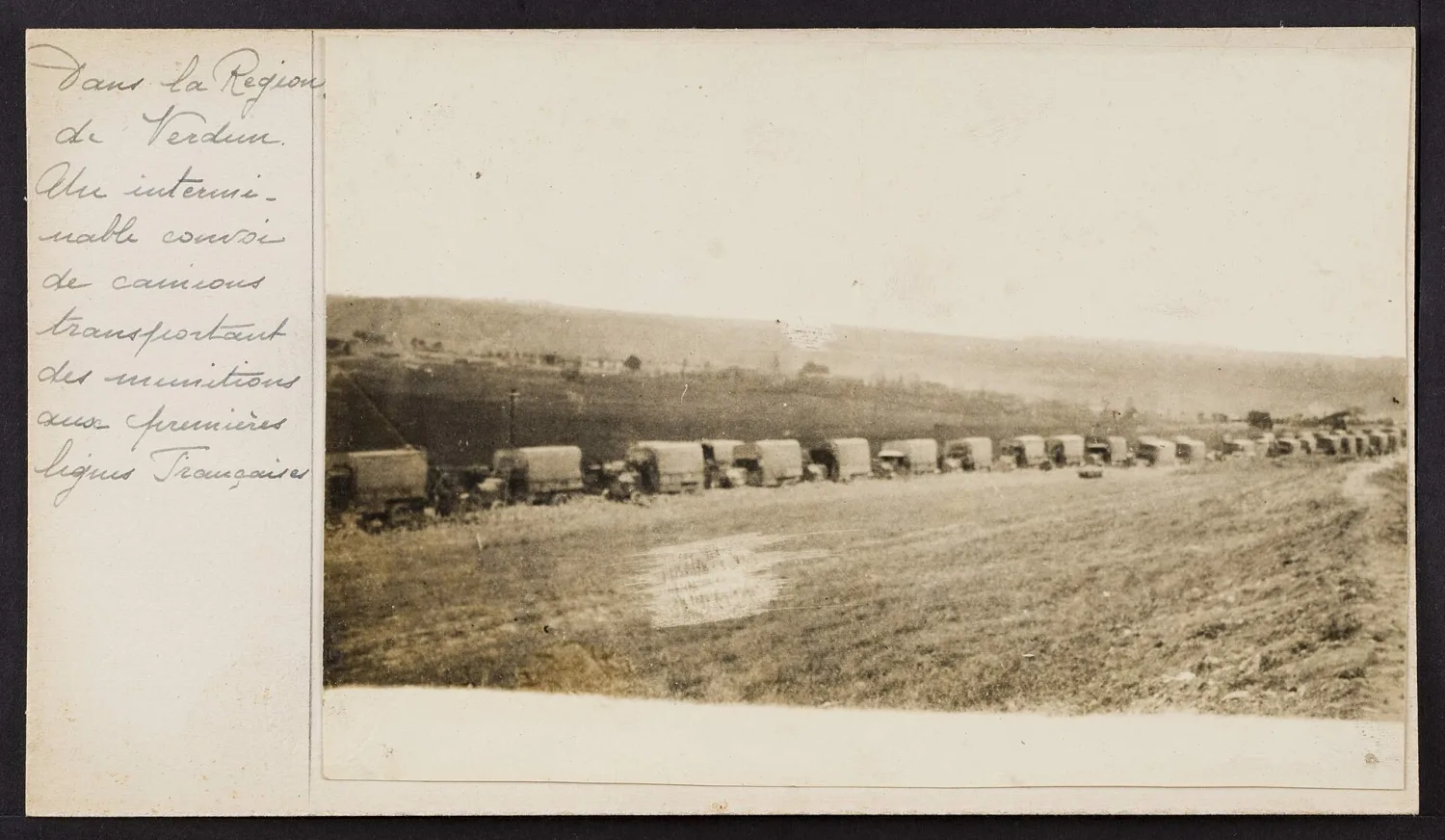
The railway into Verdun lay under German guns. What was usable was a single road of 75 kilometres to Bar-le-Duc. Pétain turned that one road into a machine. Units were assigned to the road itself; a broken-down lorry was not repaired but pushed onto the verge; gangs stayed permanently on it spreading crushed stone. From March a vehicle passed every 14 seconds on average, carrying about 90,000 men and 50,000 tonnes a week14. It became known as the Voie Sacrée.
The second device was the noria, the word for a chain of buckets that lifts water. Divisions were not left standing in the line; they were rotated through quickly and continuously. In the end 70 of the French army's 95 divisions passed through14.
This design is not a way of winning a contest of consumption. It is a way of being consumed more slowly. And it carries a price. Because losses were spread thinly and widely, no formation was destroyed and the same memory entered the whole French army. What happened in 1917 was laid down here.
Two layers: what happened, and what was designed
Germany fired the heaviest bombardment of the war on 21 February.
The aim was not a breakthrough. It started a device for calling the other side forward and processing what arrived. The infantry were used as bait, not as the objective.
Fort Douaumont fell on day five with almost no fighting.
From the design's point of view this was a success. It fixed an object the enemy would certainly come back for. For the same reason, Germany could no longer give it up either.
France fed formations in without apparent limit.
That was the noria. They were not left there; they were rotated. This was not stubbornness but management of the rate at which you are consumed.
The German offensive spread to the left bank.
The first sign of the design failing. The frontage of the machine widened to suit its own needs rather than the enemy's.
Falkenhayn was dismissed on 29 August.
The battle continued for another 111 days. With no stopping condition in the plan, removing the designer does not stop the machine.
How it went: 1916
808 guns fire about 1,000,000 shells in 10 hours; the infantry go forward in the afternoon14.
Fort Douaumont falls on day 5. About 100 German soldiers get inside against almost no resistance. The same day, Pétain takes over the Verdun front14.
The German offensive spreads to the left bank — Côte 304 and Le Mort Homme. Once the frontage widens, the premise of concentration has already collapsed.
Nivelle takes over the Verdun front; Pétain moves to higher command.
Fort Vaux falls and the Germans reach the area of Souville. This is the furthest they get. On 1 July the Anglo-French offensive opens on the Somme and pulls German reserves away.
Falkenhayn is dismissed. Hindenburg and Ludendorff succeed him.
Fort Douaumont is retaken under Nivelle. The fort lost on 25 February took 8 months to recover.
The French offensive ends and the line stands close to where it stood in February. 302 days, about 714,231 people, almost no net distance145.
Nivelle attacks on the Chemin des Dames promising a breakthrough in forty-eight hours, and fails. Mutinies spread across much of the French army.
How this differs from a design of fixation
This site already has Stalingrad, whose pattern it calls a design of fixation. There is a reason Verdun was not put in the same box.
A design of fixation pins the enemy at one point in order to decide the matter somewhere else. Pinning is the means; the winning happens elsewhere. So when the pinning stops working, there is something to fall back to.
A design of attrition has no elsewhere. The consuming is itself the route to winning, so the moment you step out of the contest, everything already spent becomes waste. You have built, yourself, a structure you cannot step out of.
To see what that does in practice, look at 29 August. The designer was removed and the battle ran on for another 111 days. Hindenburg and Ludendorff moved to wind the Verdun offensive down, and even so it did not stop at once. When a plan has no stopping condition written into it, stopping becomes a fresh decision, and a fresh decision needs grounds. The numbers that could serve as grounds do not exist inside the design.
The designs at Cannae and Austerlitz say when winning is confirmed: when the encirclement closes, when the heights are taken. Verdun has no such line.
What actually did the work
Pick a place the enemy cannot give up
Chosen for symbolic rather than military value. This judgement worked exactly as intended. France did keep feeding it.
Concentrate the guns on one point
808 guns on 30 kilometres. The first day went as planned. But concentration stops paying the moment the frontage widens.
Leave out the stopping condition
This is decisive. Nothing in the plan says how many is enough, or what to do if the ratio is bad. Nobody ends up holding grounds to stop.
Turn one road into a machine (the other side)
75 kilometres and a vehicle every 14 seconds. A contest of consumption was being decided in the rear, by throughput, not at the front.
Rotate the formations (the other side)
The noria put 70 of 95 divisions through. It avoided destruction and distributed exhaustion across the whole army.
The exit came from another battlefield
The Somme, from 1 July, pulled the German reserves away. What ended Verdun was outside Verdun. When a design has no exit in it, the exit has to arrive from outside.
Consequences: what did not die at Verdun died in 1917
The line came back to roughly where it began. France held Verdun and the German offensive did not achieve its purpose. But writing "France won" makes the case unreadable.
Pétain's noria prevented the destruction of formations, and in exchange it distributed the experience of Verdun across almost the whole French army — 70 of 95 divisions. The damage was thin, and it reached everybody.
Then in the spring of 1917, Nivelle, who had retaken Douaumont, scaled the same method up and attacked on the Chemin des Dames. He had promised a breakthrough in forty-eight hours. It failed, and mutinies spread across much of the French army immediately afterwards.
This is the heaviest part of the case. A design of attrition transfers not only to the side that built it but to the side that endured it. Having survived makes "one more push and it opens" an easy reading. The organisation that lives through a contest of consumption goes on to start one of its own.
The German consequence has the same shape. The manpower spent at Verdun and on the Somme in 1916 did not come back, and the German army of the following years became an army that could fight one decisive battle and no more. Attrition sends the same invoice to the winner.
The story: the Christmas Memorandum has never been found
Everything above rests on a design — bleeding France white — and that design raises a problem aimed at this site's own method.
The evidence for it has always been a memorandum Falkenhayn is said to have submitted to the Kaiser at Christmas 1915. That document has never been found. The only source for it is a summary in the memoirs he published in 192023.
The Prussian army archive burned in 1945, so the original cannot be checked and will not be. Work by Afflerbach and Foley questions whether the memorandum was ever a plan made in advance, or a rationalisation written afterwards for an offensive that had failed23. The actual operational orders do not state attrition as the object; what they preserve looks more like an attempt at a breakthrough.
This is inconvenient for us. Reading events as structure carries a permanent risk of mistaking a blueprint drawn afterwards for one drawn before.
The case is still treated here as a design of attrition, because whether the memorandum is genuine and whether Verdun actually operated as a machine of attrition are two different questions. 302 days, about 714,231 people, net movement close to zero. Whoever designed it, the machine certainly ran.
And if the memorandum was written afterwards, the story gets worse rather than better. It would mean a machine of attrition assembled itself unintentionally and acquired its rationale only once it was running. The stopping condition may be missing not because someone forgot to write it, but because there was no design at the start to write it into.
What carries over: on other ground
Write the stopping condition before starting a war of attrition
Price wars, litigation, long political fights — same thing. Put a number on "how much do we lose before we walk" while you are still calm enough to write it. Afterwards you will not be able to.
Check whether consuming the other side has become the objective
If the goal has quietly become outlasting them, that is the signal that the route to winning has been lost. Endurance is a cost, not a result.
Keep the exit outside
What ended Verdun was the Somme. Keep at least one route to winning that lives outside the thing you are currently doing. Without it, stepping out is instantly a total loss.
Anything that becomes a symbol changes price
Douaumont was militarily close to empty. Once something has become the name of a thing you cannot lose, it costs more than it is worth. Your own organisation has one of these.
Do not put the burden of proof on whoever says stop
In a plan with no stopping condition, the person arguing to stop is made to prove why. Not creating that asymmetry is the job of the document, not of the person.
Watch the period just after you survive
That is Nivelle in 1917. An organisation that has endured attrition overestimates how well attrition works. Having survived is not the same as having been right.
In closing: the thirteenth pattern
Stop at "Verdun was appalling" and the usable part is left behind. What is here is not madness but a design with the stopping condition missing. And designs with the stopping condition missing are far closer to hand than madness is.
That makes thirteen. Austerlitz — space; Cannae — momentum; Midway — time; Trafalgar — command; Stalingrad — fixation; Agincourt — frontage; Waterloo — junction; Vicksburg — supply; Sekigahara — defection; Normandy — deception; Tet — the verdict; Dunkirk — what to lose. And the thirteenth is attrition.
What separates it from the other twelve is that this is the only pattern that eats its designer first. Designs of space, deception or supply can fail and leave the designer free to think of the next one. A design of attrition puts the designer inside the machine at the moment it starts, because stepping out is a total loss.
So there is only one line worth writing about this pattern. If you are going to start consuming each other, write down first how it stops. Without that line it is not a strategy. It is only a machine.
Frequently asked questions
Sources
- Alistair Horne, The Price of Glory: Verdun 1916, Macmillan (1962)
- Robert T. Foley, German Strategy and the Path to Verdun: Erich von Falkenhayn and the Development of Attrition, 1870–1916, Cambridge University Press (2005)
- Holger Afflerbach, Falkenhayn: Politisches Denken und Handeln im Kaiserreich, Oldenbourg (1994)
- Paul Jankowski, Verdun: The Longest Battle of the Great War, Oxford University Press (2013)
- Ian Ousby, The Road to Verdun: France, Nationalism and the First World War, Jonathan Cape (2002)
Related cases — read in comparison