Person
Arthur Wellesley, Duke of Wellington
Commander of the Anglo-allied army
Life: 1769–1852
The commander who chose ground he could not hold alone but could win on if a promise was kept — and secured the promise first.
A commander who had refined a defensive method in the Peninsular War. The ground he chose at Waterloo had a forest behind it, a thin line of retreat and a narrow front: a position that does not explain itself, and only works on the premise that if he holds, the Prussians will come from the east. So he secured the assurance before he drew up. He chose not a position he could hold but a position he could hold if a promise was kept.
Strategic signature — position yourself on somebody else's arrival
Wellington's choice of ground does not explain itself. Behind him was the forest of Soignes and a thin line of retreat if he broke. In front was a narrow ridge under 4 km across. The position only works on the premise that if he holds, a second army will come from the east.
So before choosing the ground he secured the promise. On the evening of the 17th, having confirmed the Prussian intention to support him, he decided to stand at Mont-Saint-Jean13. He picked not a position he could hold but a position he could hold if a promise was kept — that is the design in this man.
Recurring patterns
Take position on a junction
Not ground you can hold alone, but ground you win on if help arrives — after checking that the premise will hold.
Do not settle for a verbal promise
Before drawing up he pinned down what the other party would send and how much. The choice of position depends on the quality of the assurance.
Put things where they cannot be seen
Troops behind the crest, hidden from guns and observation. You decide what the enemy is looking at.
Do not inflate the day you won
He did not hide how hard the fight had been — though how he wrote about the Prussian contribution stayed contested for decades.
Strengths and weaknesses
Reads defensive ground and builds a shape that endures.
The shape depends on somebody else arriving. The moment the promise fails, the thin line of retreat becomes the weakness.
Held a scratch multinational army together for a day.
With units of uneven quality there is nothing left for an offensive. The decision has to wait for the enemy to break.
Where the signature showed — Waterloo
The 9 hours he endured are not in themselves a victory. Enduring became victory because 48,000 men arrived from the east. Where Nelson at Trafalgar built a shape that kept moving after contact was lost, Wellington built one that did not move until somebody else came.
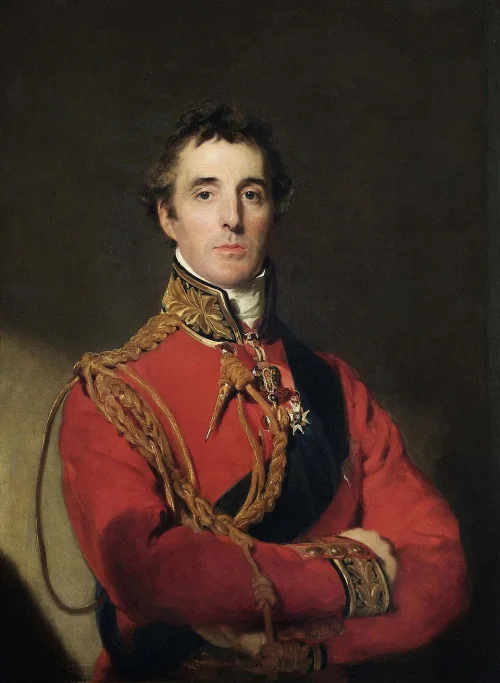
Thomas Lawrence, Arthur Wellesley, 1st Duke of Wellington, c. 1815–16, Apsley House. Painted immediately after the campaign. Public Domain, via Wikimedia Commons
Appears in