Person
Emmanuel de Grouchy
Marshal of France (commanding the detached right wing)
Life: 1766–1847
The marshal who was faithful to his order and had never been given what the order was for.
On the 17th he was given about a third of the French army and told to follow the Prussians. Nobody knew where they had gone, and the order did not say what the following was for. At midday on the 18th, when guns were heard to the west, his subordinate Gérard urged him to march to the sound; trying to be faithful to his order, he continued on Wavre. He was neither incompetent nor disloyal — he kept exactly what he had been handed. What he had not been handed was the intent.
Strategic signature — faithful to the order, never given the intent
On the 17th Grouchy was given 30,000–33,000 men and told to follow the Prussians. But nobody knew where they had gone, and the order did not say what the following was for12.
At midday on the 18th, guns were heard to the west. Gérard, one of his subordinates, urged him to march to the sound. Grouchy, trying to be faithful to his order, continued on Wavre. He was neither incompetent nor disloyal; he kept exactly what he had been handed. What he had not been handed was the intent.
Recurring patterns
Procedure can be kept; intent cannot be improvised
"Follow them" is executable, but without "in order to" there is nothing to judge by when the situation changes.
Stops the moment contact is lost
If it has not been settled what you may do when you cannot reach the top, the organisation freezes at the last instruction.
The blame gets moved onto a person
A flaw in the design is later replaced by a story about the man who did not come.
Strengths and limits
Executes an assigned task with discipline; the fighting at Wavre was not itself a defeat.
Cannot judge for himself that the task's premise has collapsed. What was delegated was the motion, not the purpose.
Connection to Waterloo
Nelson at Trafalgar deliberately created the conditions in which signals would stop working — and had distributed the intent beforehand. Napoleon distributed the procedure and not the intent. The same condition, loss of contact, produces self-propulsion on one side and a full stop on the other.
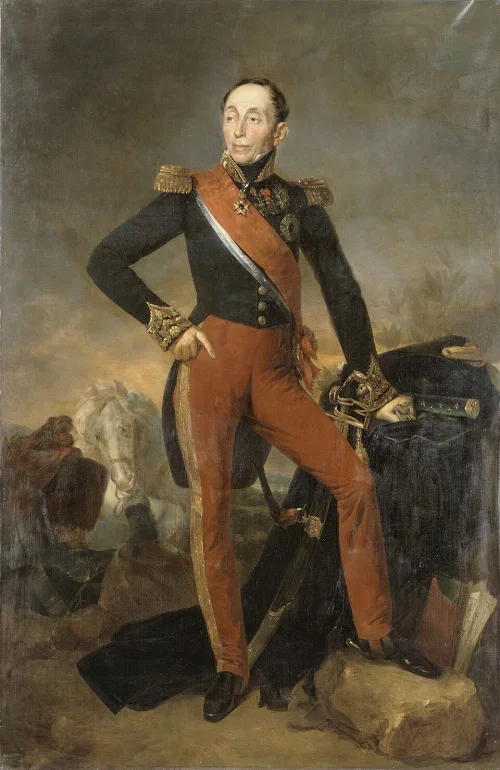
Jean Sébastien Rouillard, Emmanuel de Grouchy, 1835, Palace of Versailles — an official portrait made twenty years after the battle. Public Domain, via Wikimedia Commons
Appears in