Person
William C. Westmoreland
Commander, US Military Assistance Command, Vietnam
Life: 1914–2005
The commander who kept winning on his own yardstick and was losing on the judge's.
In a war with no front and no ground that stayed taken, he adopted the body count as the measure of progress. On that measure he was winning, and he threw the Tet attacks back within weeks. But he had fixed on Khe Sanh as the main effort and classified the attacks on the cities as the diversion — and asking, right after the victory, for another two hundred thousand men destroyed the account in which he had won. The yardstick he used was not the one the judge was using.
Strategic signature — measure victory with what can be measured
Westmoreland's war was attrition. With no front and no ground that stayed taken, the yardstick adopted for progress was the body count. If the enemy loses faster than he can replace, he eventually breaks. The logic is sound.
And on the numbers he was winning. Even at Tet, communist dead ran to more than 45,000, against 4,124 American and allied. By ratio it is a rout. But the yardstick he was using was not the one the judge was using.
Recurring patterns
Substitute a measurable indicator for victory
What cannot be measured cannot be managed, so the measurable becomes the objective. The substitution breaks the moment the indicator and the aim come apart.
Fix on where the main effort is and hold to it
He decided Khe Sanh was the main battle and massed resources there. Classifying the attacks on the cities as the diversion was the most expensive judgement in this case.
Publish an optimistic forecast
In late 1967 he said the end was coming into view. A promised forecast charges double when it is broken.
Strengths and weaknesses
Can organise very large forces and enormous firepower.
How well they are handled counts for nothing unless it registers on the indicator the judge is watching.
Tactically he threw the offensive back within weeks.
Asking immediately afterwards for 206,000 more men did not fit the account in which he had won.
Connection to Tet
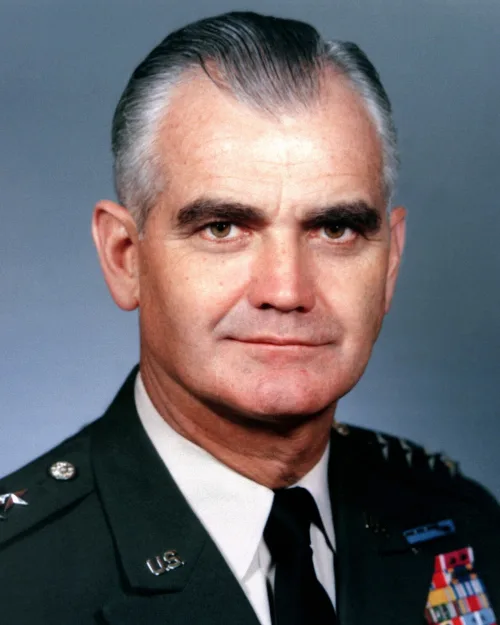
General William C. Westmoreland, 1969, US Army. Taken after he had left Vietnam to become Army Chief of Staff. Public Domain, via Wikimedia Commons
Appears in